
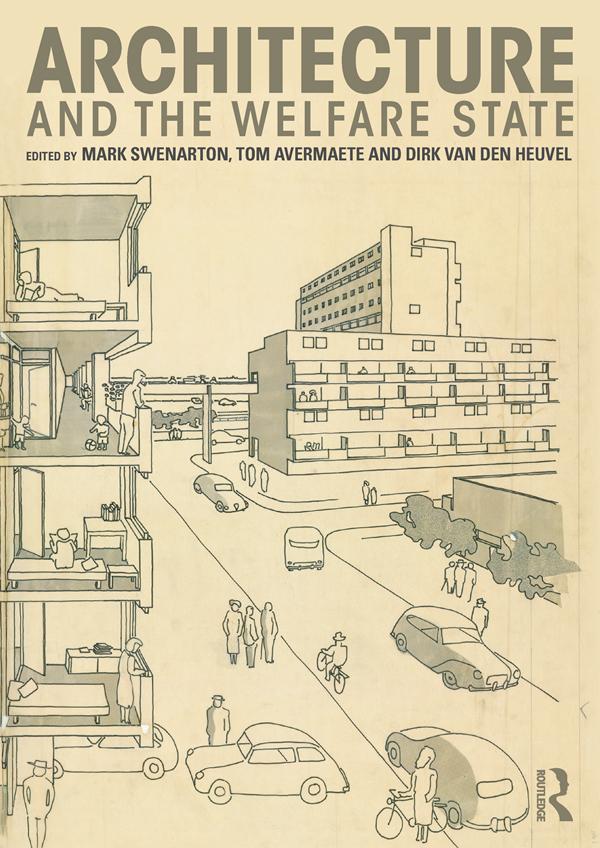
In the decades following World War Two, and in part in response to the Cold War, governments across Western Europe set out ambitious programmes for social welfare and the redistribution of wealth that aimed to improve the everyday lives of their citizens. Many of these welfare state programmes - housing, schools, new towns, cultural and leisure centres – involved not just construction but a new approach to architectural design, in which the welfare objectives of these state-funded programmes were delineated and debated. The impact on architects and architectural design was profound and far-reaching, with welfare state projects moving centre-stage in architectural discourse not just in Europe but worldwide.
This is the first book to explore the architecture of the welfare state in Western Europe from an international perspective. With chapters covering Austria, Belgium, France, Germany, Italy, The Netherlands, Sweden and the UK, the book explores the complex role played by architecture in the formation and development of the welfare state in both theory and practice.
Themes include:
- the role of the built environment in the welfare state as a political project
- the colonial dimension of European welfare state architecture and its ‘export’ to Africa and Asia
- the role of welfare state projects in promoting consumer culture and economic growth
- the picture of the collective produced by welfare state architecture
- the role of architectural innovation in the welfare state
- the role of the architect, as opposed to construction companies and others, in determining what was built
- the relationship between architectural and social theory
- the role of internal institutional critique and the counterculture.
Contributors include: Tom Avermaete, Eve Blau, Nicholas Bullock, Miles Glendinning, Janina Gosseye, Hilde Heynen, Caroline Maniaque-Benton, Helena Mattsson, Luca Molinari, Simon Pepper, Michelle Provoost, Lukasz Stanek, Mark Swenarton, Florian Urban and Dirk van den Heuvel.
Paga fácilmente con tarjeta, Klarna, Apple Pay o Google Pay. ¿No estás contento? Siempre tienes 14 días de garantía de devolución. Lee más en nuestros términos. Si tienes preguntas, escríbenos a hello@memmo.org.
Memmo hace que estudiar sea más fácil, estés donde estés. Aquí tienes tus libros de texto y herramientas de estudio inteligentes en un solo lugar: resúmenes, quizzes, podcasts y flashcards. Y también a Ted, tu compañero de estudio que responde a todo lo que te preguntes. Más de 50 000 estudiantes ya estudian aquí. Está hecho para que aprendas más rápido y te estreses menos.