
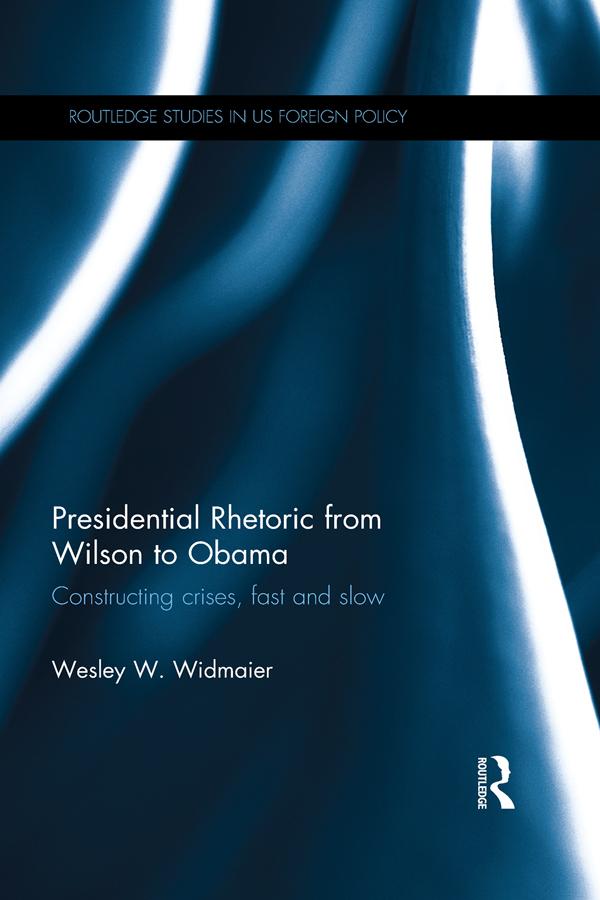
Over the past century, presidential constructions of crises have spurred recurring redefinitions of U.S. interests, as crusading advance has alternated with realist retrenchment. For example, Harry Truman and George W. Bush constructed crises that justified liberal crusades in the Cold War and War on Terror. In turn, each was followed by realist successors, as Dwight Eisenhower and Barack Obama limited U.S. commitments, but then struggled to maintain popular support.
To make sense of such dynamics, this book synthesizes constructivist and historical institutionalist insights regarding the ideational overreactions that spur shifts across crusading excesses and realist counter-reactions. Widmaier juxtaposes what Daniel Kahneman terms the initial "fast thinking" popular constructions of crises that justify liberal crusades, the "slow thinking" intellectual conversion of such views in realist adjustments, and the tensions that can lead to renewed crises. This book also traces these dynamics historically across five periods – as Wilson’s overreach limited Franklin Roosevelt to a reactive pragmatism, as Truman’s Cold War crusading incited Eisenhower’s restraint, as Kennedy-Johnson Vietnam-era crusading led to Nixon’s revived realism, as Reagan’s idealism yielded to a Bush-Clinton pragmatism, and as George W. Bush’s crusading was followed by Obama’s restraint. Widmaier concludes by addressing theoretical debates over punctuated change, historical debates over the scope for consensus, and policy debates over populist or intellectual excesses.
This work will be of great interest to students and scholars of U.S. Foreign Policy
Paga fácilmente con tarjeta, Klarna, Apple Pay o Google Pay. ¿No estás contento? Siempre tienes 14 días de garantía de devolución. Lee más en nuestros términos. Si tienes preguntas, escríbenos a hello@memmo.org.
Memmo hace que estudiar sea más fácil, estés donde estés. Aquí tienes tus libros de texto y herramientas de estudio inteligentes en un solo lugar: resúmenes, quizzes, podcasts y flashcards. Y también a Ted, tu compañero de estudio que responde a todo lo que te preguntes. Más de 50 000 estudiantes ya estudian aquí. Está hecho para que aprendas más rápido y te estreses menos.