
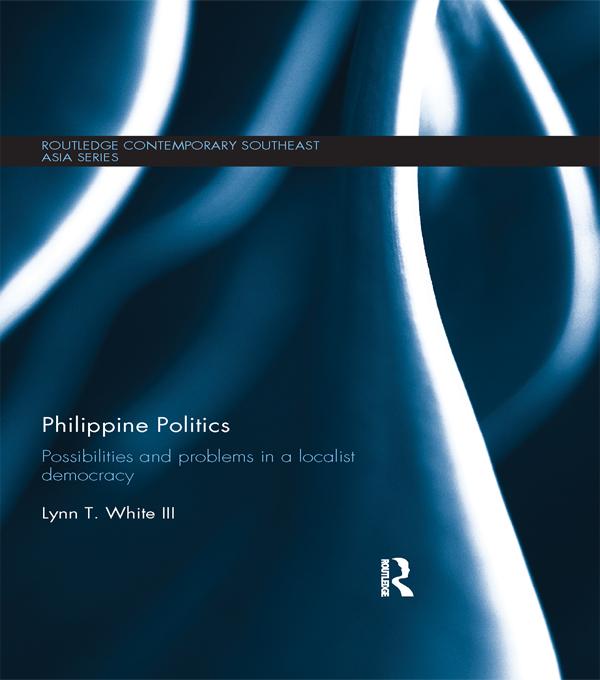
Philippine political history, especially in the twentieth century, challenges the image of democratic evolution as serving the people, and does so in ways that reveal inadequately explored aspects of many democracies. In the first decades of the twenty-first century the Philippines has nonetheless shown gradual socioeconomic "progress".
This book provides an interpretive overview of Philippine politics, and takes full account of the importance of patriotic Philippine factors in making decisions about future political policies. It analyses whether regional and local politics have more importance than national politics in the Philippines. Discussing cultural traditions of patronism, it also examines how clan feuds localize the state and create strong local policies. These conflicts in turn make regional and family-run polities collectively stronger than the central state institution. The book goes on to explore elections in the Philippines, and in particular the ways in which politicians win democratic elections, the institutionalized role of public money in this process, and the role that media plays. Offering a new interpretive overview of Philippine progress over many decades, the author notes recent economic and political changes during the current century while also trying to advance ideas that might prove useful to Filipinos.
Presenting an in-depth analysis of the problems and possibilities of politics and society in the Philippines, the book will be of interest to those researching Southeast Asian Politics, Political History and Asian Society and Culture.
Paga fácilmente con tarjeta, Klarna, Apple Pay o Google Pay. ¿No estás contento? Siempre tienes 14 días de garantía de devolución. Lee más en nuestros términos. Si tienes preguntas, escríbenos a hello@memmo.org.
Memmo hace que estudiar sea más fácil, estés donde estés. Aquí tienes tus libros de texto y herramientas de estudio inteligentes en un solo lugar: resúmenes, quizzes, podcasts y flashcards. Y también a Ted, tu compañero de estudio que responde a todo lo que te preguntes. Más de 50 000 estudiantes ya estudian aquí. Está hecho para que aprendas más rápido y te estreses menos.