
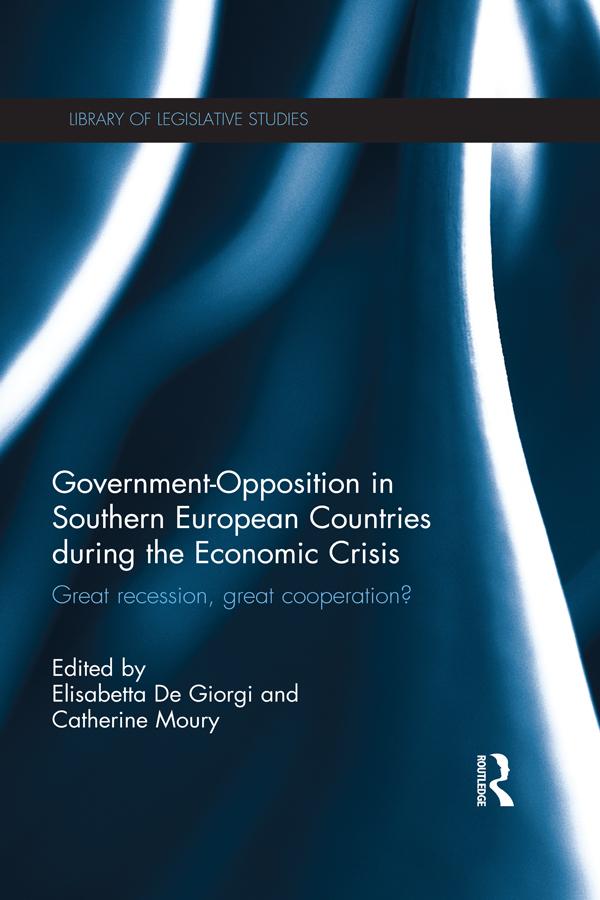
As a result of the financial crisis, opposition parties have had to choose between the need to cooperate with the majority in order to contribute to necessary socio-economic changes, and the opportunity to stress their adversarial position vis-à-vis governments taking radical and unpopular measures.
This book examines how opposition parties address this dilemma. It relies on a qualitative and quantitative analysis of the behaviour of the opposition parties in parliament, in light of the socio-economic issues that have arisen in recent years. It focuses in particular on the impact that the economic malaise has had on the government-opposition dynamics in the four southern European democracies most acutely hit by the crisis: Greece, Italy, Portugal and Spain, as well as in the European Parliament. Each chapter utilizes a combination of empirical data analysis and qualitative process-tracking to understand the opposition parties’ complicated choice between supporting and dissenting.
This book was originally published as a special issue of the Journal of Legislative Studies.
Paga fácilmente con tarjeta, Klarna, Apple Pay o Google Pay. ¿No estás contento? Siempre tienes 14 días de garantía de devolución. Lee más en nuestros términos. Si tienes preguntas, escríbenos a hello@memmo.org.
Memmo hace que estudiar sea más fácil, estés donde estés. Aquí tienes tus libros de texto y herramientas de estudio inteligentes en un solo lugar: resúmenes, quizzes, podcasts y flashcards. Y también a Ted, tu compañero de estudio que responde a todo lo que te preguntes. Más de 50 000 estudiantes ya estudian aquí. Está hecho para que aprendas más rápido y te estreses menos.