
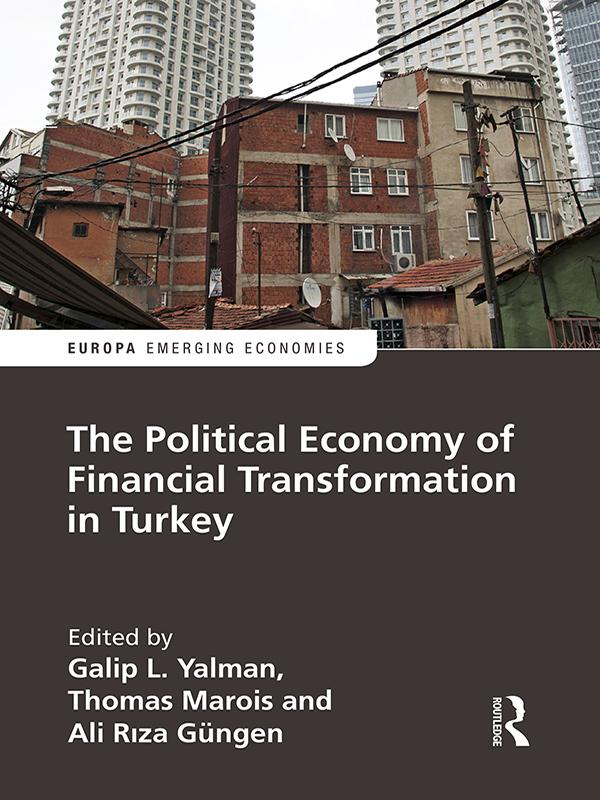
This volume provides a comprehensive study of Turkey’s financial transformation into one of the most dynamic, if not trouble-free, emerging capitalisms. While this financial evolution has underwritten Turkey’s dramatic economic growth, it has done so without ameliorating the persistently exploitative and unequal social structures that characterize neoliberalism today. This edited volume, written by an interdisciplinary range of political economists, critically examines Turkey’s financial transformation, contributing to debates on the nature of peripheral financialization.
Eschewing economistic interpretations, The Political Economy of Financial Transformation in Turkey underscores both the quantitative significance of exponential growth in financial flows and investments, and the qualitative importance of the state’s institutional restructuring around financial imperatives. The book presents today’s reality as historically rooted. By understanding the choices made under the new Republic (from 1923 onwards), one can better locate the changes launched as a newly liberalizing society (since 1980). Likewise, the decisions made in response to Turkey’s 2001 financial crisis spurred a tectonic break in state–market–society financial relations. The waves of change have reached far and wide: from corporate strategies of accumulation and growth to small- and medium-sized enterprises’ strategies of financial survival; from how finance has penetrated the provisioning of housing to how households have become financialized. Put together, one grasps the complexity and historicity of the power of contemporary finance. One also sees that the changes made have not been class-neutral, but have entailed elevating the interests of major capital groups, particularly financial capital, above the interests of the poor and workers in Turkey. Nor are these changes constrained to its national borders, as what transpires domestically contributes to the making of a financialized world market. Through this ‘Made in Turkey’ approach the contributions in this volume thus challenge dominant understandings of financialization, which are derived from the advanced capitalisms, by sharing the specificity of emerging capitalisms such as Turkey.
Paga fácilmente con tarjeta, Klarna, Apple Pay o Google Pay. ¿No estás contento? Siempre tienes 14 días de garantía de devolución. Lee más en nuestros términos. Si tienes preguntas, escríbenos a hello@memmo.org.
Memmo hace que estudiar sea más fácil, estés donde estés. Aquí tienes tus libros de texto y herramientas de estudio inteligentes en un solo lugar: resúmenes, quizzes, podcasts y flashcards. Y también a Ted, tu compañero de estudio que responde a todo lo que te preguntes. Más de 50 000 estudiantes ya estudian aquí. Está hecho para que aprendas más rápido y te estreses menos.