
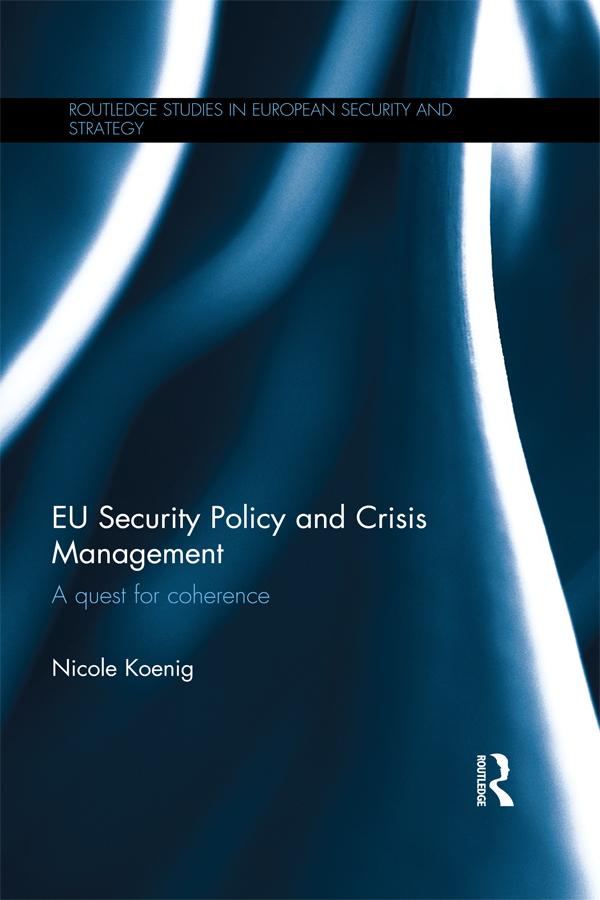
This book explores European Union crisis management and draws implications for its role as an international security actor.
The success of EU crisis management has varied greatly and this book aims to identify the key factors that explain the differing degrees of coherence through a comparative analysis of its multidimensional crisis responses in Africa. The empirical focus lies on three prominent EU crisis management cases, namely Libya in 2011, Somalia in 2011-2012, and the Sahel in 2012-2013. It analyses the activities and interaction of EU institutional actors and member states, with a focus on France, the United Kingdom, and Germany. The book argues that the EU represents a rather unpredictable security actor, whose multi-level coherence is contingent on the congruence of domestic economic and electoral interests, as well as national threat perceptions, and the extent to which EU-level coherence norms resonate with national norms on the use of force and modes of multilateral cooperation. In sum, this book offers systematic insight into EU crisis management and clarifies the conceptual and empirical boundaries of the comprehensive approach. Finally, the study of the micro-foundations of coherence allows for policy-relevant suggestions on the EU’s future role as a security actor.
This book will be of much interest to students of EU policy, European Security, Peace and Conflict Studies, African Politics and IR in general.
Paga fácilmente con tarjeta, Klarna, Apple Pay o Google Pay. ¿No estás contento? Siempre tienes 14 días de garantía de devolución. Lee más en nuestros términos. Si tienes preguntas, escríbenos a hello@memmo.org.
Memmo hace que estudiar sea más fácil, estés donde estés. Aquí tienes tus libros de texto y herramientas de estudio inteligentes en un solo lugar: resúmenes, quizzes, podcasts y flashcards. Y también a Ted, tu compañero de estudio que responde a todo lo que te preguntes. Más de 50 000 estudiantes ya estudian aquí. Está hecho para que aprendas más rápido y te estreses menos.