
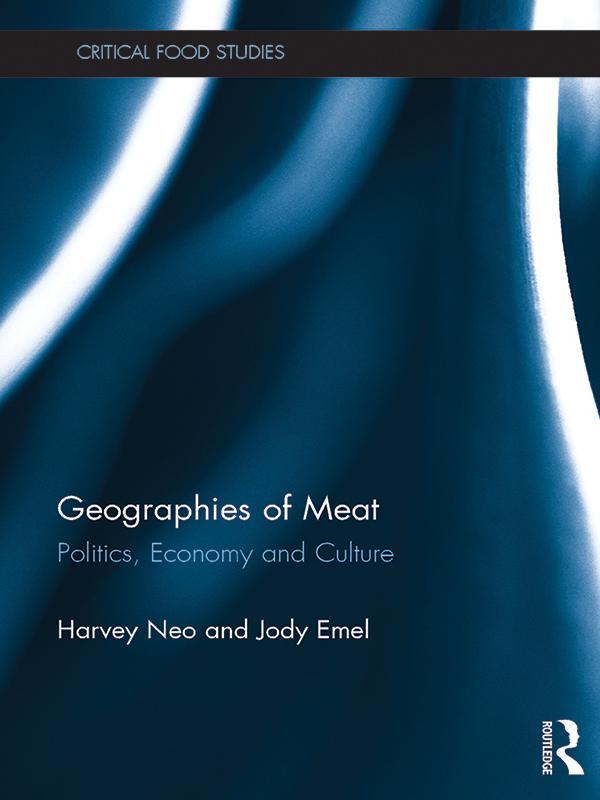
With the ever rising demand for meat around the world, the production of meat has changed dramatically in the past few decades. What has brought about the increasing popularity and attendant normalization of factory farms across many parts of the world? What are some of the ways to resist such broad convergences in meat production and how successful are they?
This book locates the answers to these questions at the intersection between the culture, science and political economy of meat production and consumption. It details how and why techniques of production have spread across the world, albeit in a spatially uneven way. It argues that the modern meat production and consumption sphere is the outcome of a complex matrix of cultural politics, economics and technological faith. Drawing from examples across the world (including America, Europe and Asia), the tensions and repercussions of meat production and consumption are also analyzed.
From a geographical perspective, food animals have been given considerably less attention compared to wild animals or pets. This book, framed conceptually by critical animal studies, governmentality and commodification, is a theoretically driven and empirically rich study that advances the study of food animals in geography as well as in the wider social sciences.
Paga fácilmente con tarjeta, Klarna, Apple Pay o Google Pay. ¿No estás contento? Siempre tienes 14 días de garantía de devolución. Lee más en nuestros términos. Si tienes preguntas, escríbenos a hello@memmo.org.
Memmo hace que estudiar sea más fácil, estés donde estés. Aquí tienes tus libros de texto y herramientas de estudio inteligentes en un solo lugar: resúmenes, quizzes, podcasts y flashcards. Y también a Ted, tu compañero de estudio que responde a todo lo que te preguntes. Más de 50 000 estudiantes ya estudian aquí. Está hecho para que aprendas más rápido y te estreses menos.