
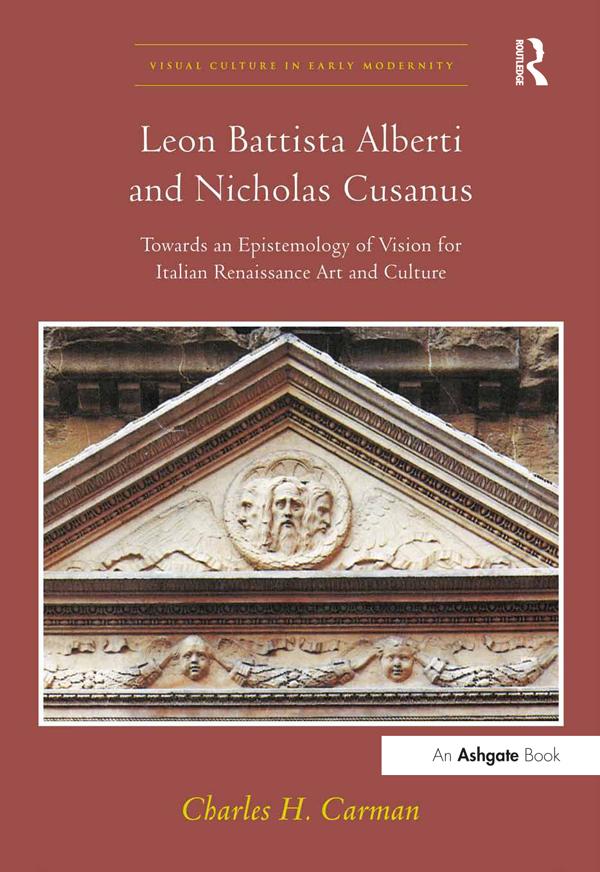
Providing a fresh evaluation of Alberti’s text On Painting (1435), along with comparisons to various works of Nicholas Cusanus - particularly his Vision of God (1450) - this study reveals a shared epistemology of vision. And, the author argues, it is one that reflects a more deeply Christian Neoplatonic ideal than is typically accorded Alberti. Whether regarding his purpose in teaching the use of a geometric single point perspective system, or more broadly in rendering forms naturalistically, the emphasis leans toward the ideal of Renaissance art as highly rational. There remains the impression that the principle aim of the painter is to create objective, even illusionistic images. A close reading of Alberti’s text, however, including some adjustments in translation, points rather towards an emphasis on discerning the spiritual in the material. Alberti’s use of the tropes Minerva and Narcissus, for example, indicates the opposing characteristics of wisdom and sense certainty that function dialectically to foster the traditional importance of seeing with the eye of the intellect rather than merely with physical eyes. In this sense these figures also set the context for his, and, as the author explains, Brunelleschi’s earlier invention of this perspective system that posits not so much an objective seeing as an opposition of finite and infinite seeing, which, moreover, approximates Cusanus’s famous notion of a coincidence of opposites. Together with Alberti’s and Cusanus’s ideals of vision, extensive analysis of art works discloses a ubiquitous commitment to stimulating an intellectual perception of divine, essential, and unseen realities that enliven the visible material world.
Paga fácilmente con tarjeta, Klarna, Apple Pay o Google Pay. ¿No estás contento? Siempre tienes 14 días de garantía de devolución. Lee más en nuestros términos. Si tienes preguntas, escríbenos a hello@memmo.org.
Memmo hace que estudiar sea más fácil, estés donde estés. Aquí tienes tus libros de texto y herramientas de estudio inteligentes en un solo lugar: resúmenes, quizzes, podcasts y flashcards. Y también a Ted, tu compañero de estudio que responde a todo lo que te preguntes. Más de 50 000 estudiantes ya estudian aquí. Está hecho para que aprendas más rápido y te estreses menos.
También te podría gustar
Comprar el libro0