
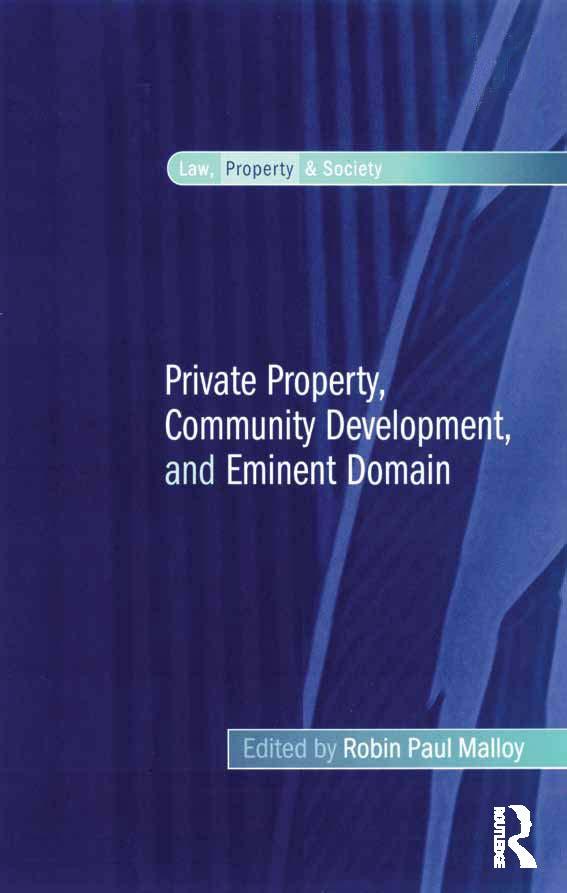
The contributors in this volume address the fundamental relationship between the state and its citizens, and among the people themselves. Discussion centers on a recent decision by the United States Supreme Court in the case of Kelo v. City of New London. This case involved the use of eminent domain power to acquire private property for purposes of transferring it by the State to another private party that would make "better" economic use of the land. This type of state action has been identified as an "economic development taking". In the Kelo case, the Court held that the action was legal within provisions of the US Constitution but the opinion was contentious among some of the Justices and has been met with significant negative outcry from the public. The Kelo case and the public debate arising in its aftermath give cause to assess the legal landscape related to the ability of government to fairly balance the tension between private property and the public interest. The tension and the need to successfully strike a balance are not unique to any one country or any one political system. From the United States to the United Kingdom, to the People's Republic of China, property and its legal regulation are of prime importance to matters of economic development and civic institution building. The Kelo decision, therefore, explores a rich set of legal principles with broad applicability.
Paga fácilmente con tarjeta, Klarna, Apple Pay o Google Pay. ¿No estás contento? Siempre tienes 14 días de garantía de devolución. Lee más en nuestros términos. Si tienes preguntas, escríbenos a hello@memmo.org.
Memmo hace que estudiar sea más fácil, estés donde estés. Aquí tienes tus libros de texto y herramientas de estudio inteligentes en un solo lugar: resúmenes, quizzes, podcasts y flashcards. Y también a Ted, tu compañero de estudio que responde a todo lo que te preguntes. Más de 50 000 estudiantes ya estudian aquí. Está hecho para que aprendas más rápido y te estreses menos.
También te podría gustar
Comprar el libro0