
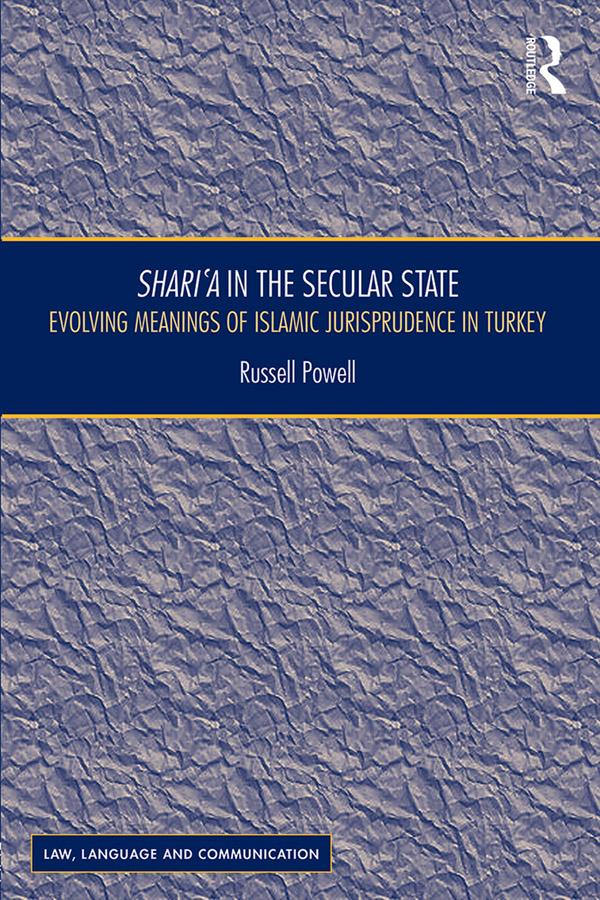
Words in both law and religion can shape power relationships and are often highly disputed. Shari`a lies within the overlap of these two spheres and provides a unique subject for the study of meaning in that liminal space. This book contributes important insights related to Islamic jurisprudence and secularism in the Turkish context and regarding the role of language in contested legal and religious contexts.
The study begins by providing a historical framework for the ideas and terms covered, including concepts of religion in general, Shari`a in particular, and secularism in the Turkish state. It goes on to examine empirical research to describe and analyze contemporary Turkish understandings of religion and Shari`a. The author’s research indicates that there is often a disconnect between supporting the adoption of Shari`a and supporting the regulation of everyday behavior through civil codes. Thus, “Shari`a” seems to have taken on new meanings as groups have sought either to appropriate or criticize it. It is a quintessential example of fractured and contextual meaning at the center of both religious and legal traditions.
This book is essential reading for both academics and those interested in law, linguistics, history, political science, anthropology, sociology, religious studies, or Near Eastern studies.
Paga fácilmente con tarjeta, Klarna, Apple Pay o Google Pay. ¿No estás contento? Siempre tienes 14 días de garantía de devolución. Lee más en nuestros términos. Si tienes preguntas, escríbenos a hello@memmo.org.
Memmo hace que estudiar sea más fácil, estés donde estés. Aquí tienes tus libros de texto y herramientas de estudio inteligentes en un solo lugar: resúmenes, quizzes, podcasts y flashcards. Y también a Ted, tu compañero de estudio que responde a todo lo que te preguntes. Más de 50 000 estudiantes ya estudian aquí. Está hecho para que aprendas más rápido y te estreses menos.