
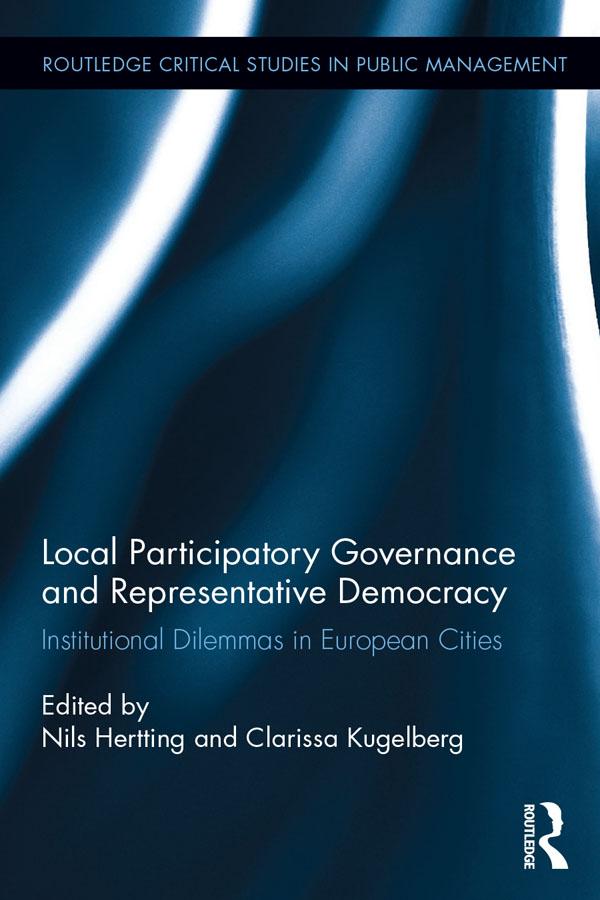
Over the past few decades and throughout the world, numerous government-initiated experiments and attempts at directly engaging and including citizens have emerged as remedies for a variety of problems faced by modern democracies, including political disaffection and insufficient capacity to deal with the complexity inherent in many contemporary public problems, such as climate change and segregation.
In practice, these attempts are given many names, such as citizen panels, deliberative fora, collaborative dialogues, etc. In the academic literature as well, the phenomenon falls under many different headings, for instance collaborative, deliberative or interactive governance.
Participatory Governance and Representative Democracy refers to this empirical phenomenon as local participatory governance, that is, government-sponsored direct participation between invited citizens and local officials in concrete arrangements and concerning problems that affect them. Participatory governance, we argue, may take many forms, regarding (1) type of interaction and type of communication between participants within the specific participatory arrangement (e.g., deliberative vs. aggregative) as well as regarding (2) the relation and connection between the specific arrangement and the more traditional representative structures (e.g., compatible, incompatible, transformative or irrelevant).
The proposed edited volume addresses the matter of institutionalization, highlighting the difficulties associated with establishing stability and a shared understanding of the roles and rules among citizens, local politicians and administrators in participatory arrangements.
Paga fácilmente con tarjeta, Klarna, Apple Pay o Google Pay. ¿No estás contento? Siempre tienes 14 días de garantía de devolución. Lee más en nuestros términos. Si tienes preguntas, escríbenos a hello@memmo.org.
Memmo hace que estudiar sea más fácil, estés donde estés. Aquí tienes tus libros de texto y herramientas de estudio inteligentes en un solo lugar: resúmenes, quizzes, podcasts y flashcards. Y también a Ted, tu compañero de estudio que responde a todo lo que te preguntes. Más de 50 000 estudiantes ya estudian aquí. Está hecho para que aprendas más rápido y te estreses menos.