
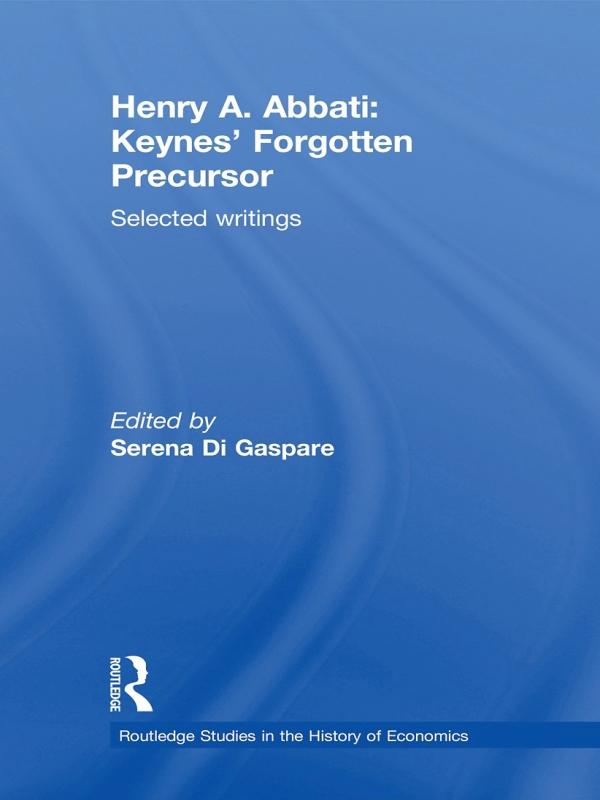
Henry A. Abbati was not an economist by profession. After retiring from business, in 1924 he published his first book, The Unclaimed Wealth: How Money Stops Production in which he expounded his theory of ‘effective demand’ (terminology of his own) and its differences with respect to current theories on economic fluctuations. He was advocating public intervention in the economy in the crisis. His second book, The Final Buyer marshalled his criticisms of current theories and further clarified salient aspects of his theory, such as ‘saving’ and its various definitions, the working of the banking system, the interest rate and the role of public works as a means of reducing unemployment. Later work in the 30s and 40s looked at full employment, reflections on the economic crisis and further analysis of the concept of unclaimed wealth.
In many ways Abbati’s work in the twenties was an important precursor to Keynes’ Treatise on Money, though despite being admired by Robertson and indeed Keynes, his work is today largely unknown and entirely ignored by the numerous authors who have examined the debate of the twenties and thirties on the crises and business cycles and by academic opinion in general. In this book, Di Gaspare restores Abbati’s position as a pioneer in macroeconomic theory with a selection of his writings and a far reaching introduction to his contribution to the history of economic thought.
Paga fácilmente con tarjeta, Klarna, Apple Pay o Google Pay. ¿No estás contento? Siempre tienes 14 días de garantía de devolución. Lee más en nuestros términos. Si tienes preguntas, escríbenos a hello@memmo.org.
Memmo hace que estudiar sea más fácil, estés donde estés. Aquí tienes tus libros de texto y herramientas de estudio inteligentes en un solo lugar: resúmenes, quizzes, podcasts y flashcards. Y también a Ted, tu compañero de estudio que responde a todo lo que te preguntes. Más de 50 000 estudiantes ya estudian aquí. Está hecho para que aprendas más rápido y te estreses menos.