
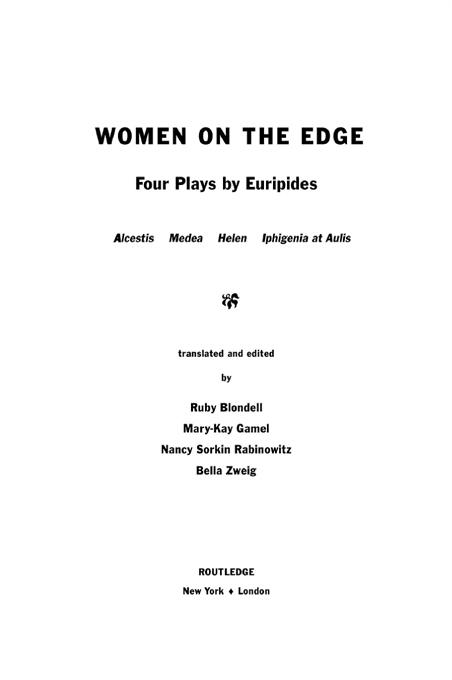
Women on the Edge, a collection of Alcestis, Medea, Helen, and Iphegenia at Aulis, provides a broad sample of Euripides' plays focusing on women, and spans the chronology of his surviving works, from the earliest, to his last, incomplete, and posthumously produced masterpiece. Each play shows women in various roles--slave, unmarried girl, devoted wife, alienated wife, mother, daughter--providing a range of evidence about the kinds of meaning and effects the category woman conveyed in ancient Athens. The female protagonists in these plays test the boundaries--literal and conceptual--of their lives.
Although women are often represented in tragedy as powerful and free in their thoughts, speech and actions, real Athenian women were apparently expected to live unseen and silent, under control of fathers and husbands, with little political or economic power. Women in tragedy often disrupt "normal" life by their words and actions: they speak out boldly, tell lies, cause public unrest, violate custom, defy orders, even kill. Female characters in tragedy take actions, and raise issues central to the plays in which they appear, sometimes in strong opposition to male characters. The four plays in this collection offer examples of women who support the status quo and women who oppose and disrupt it; sometimes these are the same characters.
Paga fácilmente con tarjeta, Klarna, Apple Pay o Google Pay. ¿No estás contento? Siempre tienes 14 días de garantía de devolución. Lee más en nuestros términos. Si tienes preguntas, escríbenos a hello@memmo.org.
Memmo hace que estudiar sea más fácil, estés donde estés. Aquí tienes tus libros de texto y herramientas de estudio inteligentes en un solo lugar: resúmenes, quizzes, podcasts y flashcards. Y también a Ted, tu compañero de estudio que responde a todo lo que te preguntes. Más de 50 000 estudiantes ya estudian aquí. Está hecho para que aprendas más rápido y te estreses menos.