
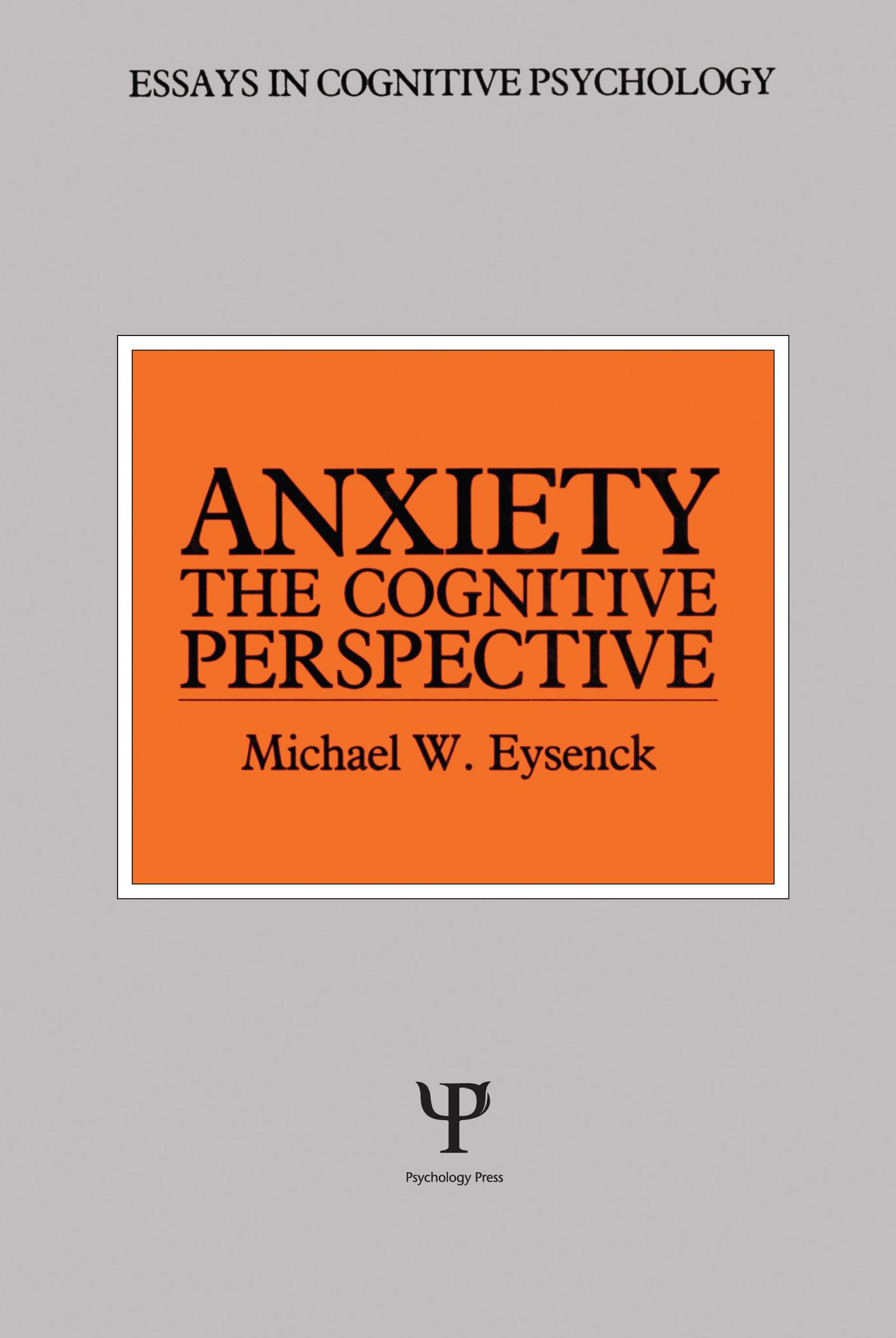
Theorists are increasingly arguing that it is fruitful to approach anxiety from the cognitive perspective, and the empirical evidence supports that contention. The cognitive perspective is also adopted in this book, but the approach represents a development and extension of earlier ones. For example, most previous theories and research have been based on anxiety either in clinical or in normal groups. In contrast, one of the central themes of this book is that there are great advantages to be gained from a joint consideration of clinical and normal anxiety.
Another theme of this book is that it is of major importance to establish whether or not there is a cognitive vulnerability factor which is associated with at least some forms of clinical anxiety. It is argued (with supporting evidence) that there is a latent cognitive vulnerability factor for generalized anxiety disorder which manifests itself under stressful conditions. This vulnerability factor is characterized by hypervigilance, and is found predominantly in normals high in the personality dimension of trait anxiety.
The scope of the book extends to the effects of anxiety on performance and to the phenomenon of worry, which is regarded as the cognitive component of anxiety. In both cases, a new theoretical framework is presented.
Correction notice: In chapter 4, on pages 70-71, Christos Halkiopoulos should have been credited for his role as the inventor of the Dot Probe Paradigm and for the design and execution of the experiment discussed in Eysenck, M. W. (1991 a). Trait anxiety and cognition. In C. D. Spielberger, I. G. Sarason, Z. Kulczar, and J. Van Heck (Eds.), Stress and Emotion, Vol. 14. London: Hemisphere.
Paga fácilmente con tarjeta, Klarna, Apple Pay o Google Pay. ¿No estás contento? Siempre tienes 14 días de garantía de devolución. Lee más en nuestros términos. Si tienes preguntas, escríbenos a hello@memmo.org.
Memmo hace que estudiar sea más fácil, estés donde estés. Aquí tienes tus libros de texto y herramientas de estudio inteligentes en un solo lugar: resúmenes, quizzes, podcasts y flashcards. Y también a Ted, tu compañero de estudio que responde a todo lo que te preguntes. Más de 50 000 estudiantes ya estudian aquí. Está hecho para que aprendas más rápido y te estreses menos.