
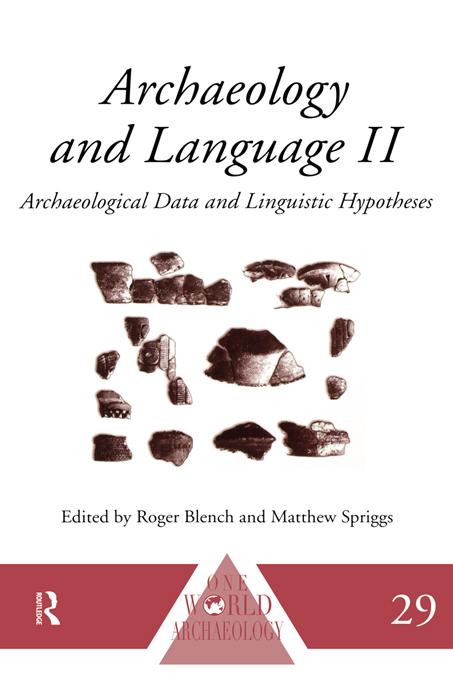
Using language to date the origin and spread of food production, Archaeology and Language II represents groundbreaking work in synthesizing two disciplines that are now seen as interlinked: linguistics and archaeology. This volume is the second part of a three-part survey of innovative results emerging from their combination.
Archaeology and historical linguistics have largely pursued separate tracks until recently, although their goals can be very similar. While there is a new awareness that these disciplines can be used to complement one another, both rigorous methodological awareness and detailed case-studies are still lacking in the literature. This three-part survey is the first study to address this.
Archaeology and Language II examines in some detail how archaeological data can be interpreted through linguistic hypotheses. This collection demonstrates the possibility that, where archaeological sequences are reasonably well-known, they might be tied into evidence of language diversification and thus produce absolute chronologies. Where there is evidence for migrations and expansions these can be explored through both disciplines to produce a richer interpretation of prehistory. An important part of this is the origin and spread of food production which can be modelled through the spread of both plants and words for them.
Archaeology and Language II will be of interest to researchers in linguistics, archaeologists and anthropologists.
Paga fácilmente con tarjeta, Klarna, Apple Pay o Google Pay. ¿No estás contento? Siempre tienes 14 días de garantía de devolución. Lee más en nuestros términos. Si tienes preguntas, escríbenos a hello@memmo.org.
Memmo hace que estudiar sea más fácil, estés donde estés. Aquí tienes tus libros de texto y herramientas de estudio inteligentes en un solo lugar: resúmenes, quizzes, podcasts y flashcards. Y también a Ted, tu compañero de estudio que responde a todo lo que te preguntes. Más de 50 000 estudiantes ya estudian aquí. Está hecho para que aprendas más rápido y te estreses menos.