
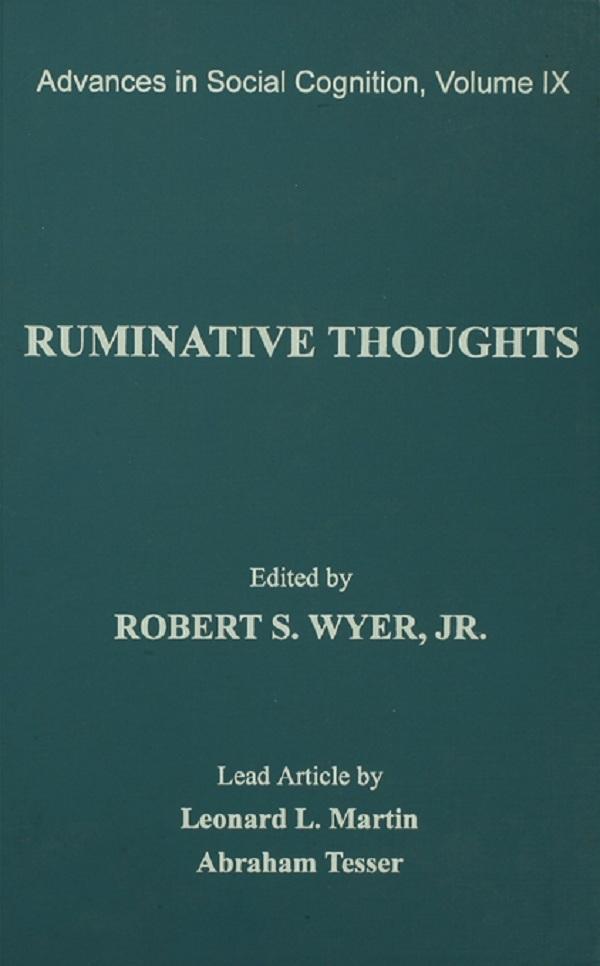
Until recently, most theory and research in social information processing has focused attention on the cognitive activity that underlies responses to stimulus information presented in the immediate situation being investigated. In contrast, people's thoughts outside the laboratory often concern life events that either have occurred in the past or are likely to occur in the future. Thoughts about such past and future events can be spontaneous and, once elicited, can affect the ability to respond effectively to the demands of the present situation with which one is confronted.
This ninth volume in this series focuses on this type of cognitive activity and examines both its determinants and consequences. The lead article, by Leonard Martin and Abraham Tesser, develops a theoretical formulation of ruminative thinking that conceptualizes rumination as a class of conscious thought with a common instrumental theme that recurs in the absence of immediate environmental demands. The authors also give particular attention to the ways in which perceptions of the consequences of past and present events for long-range goal attainment affect both controlled and uncontrolled thinking about these events. They also examine the implications of their theory for the ability to suppress unwanted thoughts, the interplay of emotion and cognition, and the cognitive consequences or rumination for the performance of daily life activities. The entire formulation integrates a number of cognitive phenomena that are not usually considered within a single theoretical framework.
The companion chapters, many written by the field's foremost contributors to the literature on emotion and cognition, suggest important refinements and extensions of the conceptualization proposed in the target article. They also make important conceptual contributions in their own right, covering topics that include the role of mental models in cognitive functioning, the dynamics of thought suppression and attentional inhibition, stress and coping, personality correlates of ruminative thought, and attitudes and persuasion. As a result, this volume makes a valuable contribution to research and theory not only in social cognition but also in numerous other areas.
Paga fácilmente con tarjeta, Klarna, Apple Pay o Google Pay. ¿No estás contento? Siempre tienes 14 días de garantía de devolución. Lee más en nuestros términos. Si tienes preguntas, escríbenos a hello@memmo.org.
Memmo hace que estudiar sea más fácil, estés donde estés. Aquí tienes tus libros de texto y herramientas de estudio inteligentes en un solo lugar: resúmenes, quizzes, podcasts y flashcards. Y también a Ted, tu compañero de estudio que responde a todo lo que te preguntes. Más de 50 000 estudiantes ya estudian aquí. Está hecho para que aprendas más rápido y te estreses menos.
También te podría gustar
Comprar el libro0