
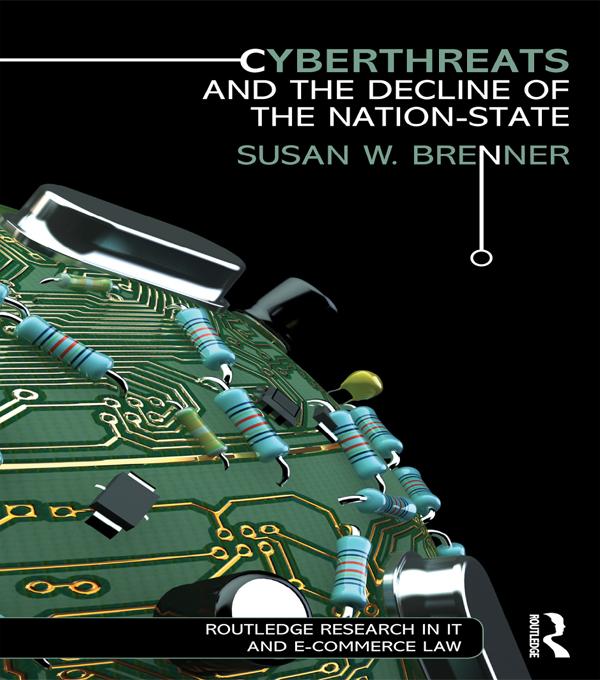
This book explores the extraordinary difficulties a nation-state’s law enforcement and military face in attempting to prevent cyber-attacks. In the wake of recent assaults including the denial of service attack on Estonia in 2007 and the widespread use of the Zeus Trojan Horse software, Susan W. Brenner explores how traditional categories and procedures inherent in law enforcement and military agencies can obstruct efforts to respond to cyberthreats. Brenner argues that the use of a territorially-based system of sovereignty to combat cyberthreats is ineffective, as cyberspace erodes the import of territory. This problem is compounded by the nature of cybercrime as a continually evolving phenomenon driven by rapid and complex technological change.
Following an evaluation of the efficacy of the nation-state, the book goes on to explore how individuals and corporations could be integrated into a more decentralized, distributed system of cyberthreat control. Looking at initiatives in Estonia and Sweden which have attempted to incorporate civilians into their cyber-response efforts, Brenner suggests that civilian involvement may mediate the rigid hierarchies that exist among formal agencies and increase the flexibility of any response. This book will be of great interest to students and researchers of information technological law and security studies.
Paga fácilmente con tarjeta, Klarna, Apple Pay o Google Pay. ¿No estás contento? Siempre tienes 14 días de garantía de devolución. Lee más en nuestros términos. Si tienes preguntas, escríbenos a hello@memmo.org.
Memmo hace que estudiar sea más fácil, estés donde estés. Aquí tienes tus libros de texto y herramientas de estudio inteligentes en un solo lugar: resúmenes, quizzes, podcasts y flashcards. Y también a Ted, tu compañero de estudio que responde a todo lo que te preguntes. Más de 50 000 estudiantes ya estudian aquí. Está hecho para que aprendas más rápido y te estreses menos.