
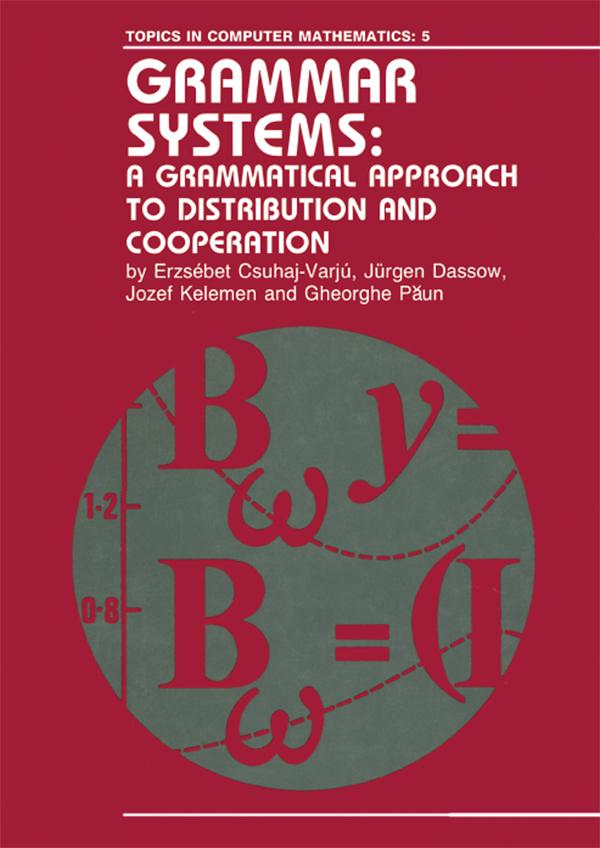
First Published in 1994. The central problem of the “classic” formal language theory concerns the generation (the recognition) of languages by grammars (automata, respectively). However, in present day computer science, in artificial intelligence, in cognitive psychology and in other related fields we have to deal more and more with complex tasks distributed among a set of “ processors” , which are working together in a well defined way. Parallel computers, computer nets, distributed data bases and knowledge sources are practical materializations of this idea. Similarly, the psychologists speak about the modularity of mind, in problem solving theories there appear many models based on cognitive agents’ cooperation. As the formal language theory is involved in most of these circumstances (for example, as a theoretical framework, well developed from a mathematical point of view, for modelling aspects whose essence can be captured at the level of symbol systems, of the syntax of collections of strings of abstract symbols), a clear challenge appears for it: to consider systems o f grammars/automata, working together for generating/recognizing a language. In this context, notions such as distribution, cooperation, communication, concurrency, synchronization, parallelism etc. should be formalized and enlightened. The present monograph is an attempt to answer this challenge.
Paga fácilmente con tarjeta, Klarna, Apple Pay o Google Pay. ¿No estás contento? Siempre tienes 14 días de garantía de devolución. Lee más en nuestros términos. Si tienes preguntas, escríbenos a hello@memmo.org.
Memmo hace que estudiar sea más fácil, estés donde estés. Aquí tienes tus libros de texto y herramientas de estudio inteligentes en un solo lugar: resúmenes, quizzes, podcasts y flashcards. Y también a Ted, tu compañero de estudio que responde a todo lo que te preguntes. Más de 50 000 estudiantes ya estudian aquí. Está hecho para que aprendas más rápido y te estreses menos.
También te podría gustar
Comprar el libro0