
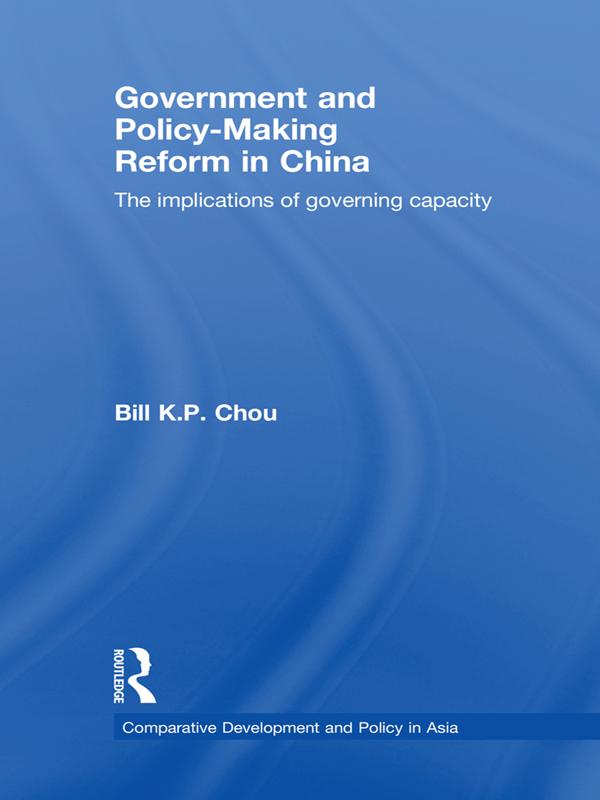
China’s rapid economic development has not translated automatically into political development, with many of its institutions still in need of major reform. In the post-Mao era, despite the decentralization of local government with significant administrative and fiscal authority, China’s government and policy-making processes have retained much of the inefficiency and corruption characteristic of the earlier period.
This book analyzes the implementation of government and policy-making reform in China, focusing in particular on the reform programmes instituted since the early 1990s. It considers all the important areas of reform, including the enhancement of policy-making capacity, reform of taxation and fund transfer policies, tightening of financial control, civil service reform and market deregulation. Bill K.P Chou assesses the course of policy reform in each of these areas, considers how successful reforms have been, and outlines what remains to be done. In particular, he explores the impact on the reform process of China’s entry into the WTO in 2001, demonstrating that the process of reform in China has been one of continuous conflict between the agenda of political elites in central government, and the priorities of local leaders, with local agents often distorting, delaying or ignoring the policies emanating from the central government.
Paga fácilmente con tarjeta, Klarna, Apple Pay o Google Pay. ¿No estás contento? Siempre tienes 14 días de garantía de devolución. Lee más en nuestros términos. Si tienes preguntas, escríbenos a hello@memmo.org.
Memmo hace que estudiar sea más fácil, estés donde estés. Aquí tienes tus libros de texto y herramientas de estudio inteligentes en un solo lugar: resúmenes, quizzes, podcasts y flashcards. Y también a Ted, tu compañero de estudio que responde a todo lo que te preguntes. Más de 50 000 estudiantes ya estudian aquí. Está hecho para que aprendas más rápido y te estreses menos.