
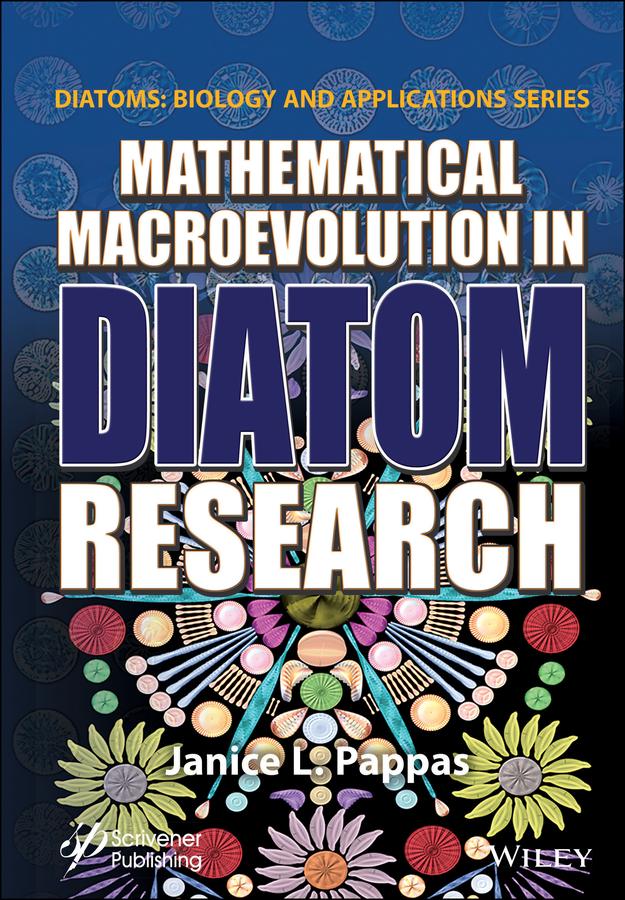
Buy this book to learn how to use mathematics in macroevolution research and apply mathematics to study complex biological problems.
This book contains recent research in mathematical and analytical studies on diatoms. These studies reflect the complex and intricate nature of the problems being analyzed and the need to use mathematics as an aid in finding solutions. Diatoms are important components of marine food webs, the silica and carbon cycles, primary productivity, and carbon sequestration. Their uniqueness as glass-encased unicells and their presence throughout geologic history exemplifies the need to better understand such organisms. Explicating the role of diatoms in the biological world is no more urgent than their role as environmental and climate indicators, and as such, is aided by the mathematical studies in this book.
The volume contains twelve original research papers as chapters. Macroevolutionary science topics covered are morphological analysis, morphospace analysis, adaptation, food web dynamics, origination-extinction and diversity, biogeography, life cycle dynamics, complexity, symmetry, and evolvability. Mathematics used in the chapters include stochastic and delay differential and partial differential equations, differential geometry, probability theory, ergodic theory, group theory, knot theory, statistical distributions, chaos theory, and combinatorics. Applied sciences used in the chapters include networks, machine learning, robotics, computer vision, image processing, pattern recognition, and dynamical systems. The volume covers a diverse range of mathematical treatments of topics in diatom research.
Audience
Diatom researchers, mathematical biologists, evolutionary and macroevolutionary biologists, paleontologists, paleobiologists, theoretical biologists, as well as researchers in applied mathematics, algorithm sciences, complex systems science, computational sciences, informatics, computer vision and image processing sciences, nanoscience, the biofuels industry, and applied engineering.
Paga fácilmente con tarjeta, Klarna, Apple Pay o Google Pay. ¿No estás contento? Siempre tienes 14 días de garantía de devolución. Lee más en nuestros términos. Si tienes preguntas, escríbenos a hello@memmo.org.
Memmo hace que estudiar sea más fácil, estés donde estés. Aquí tienes tus libros de texto y herramientas de estudio inteligentes en un solo lugar: resúmenes, quizzes, podcasts y flashcards. Y también a Ted, tu compañero de estudio que responde a todo lo que te preguntes. Más de 50 000 estudiantes ya estudian aquí. Está hecho para que aprendas más rápido y te estreses menos.