
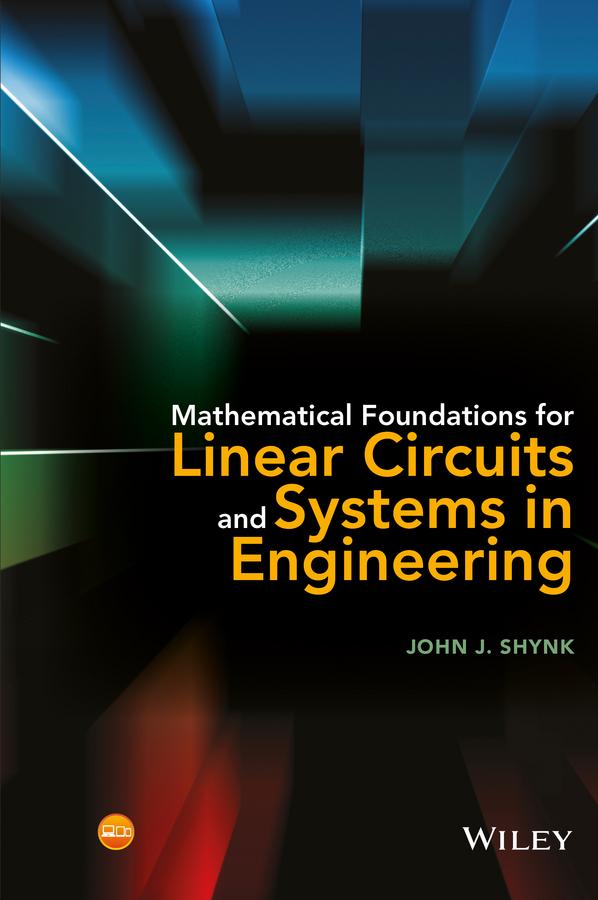
Extensive coverage of mathematical techniques used in engineering with an emphasis on applications in linear circuits and systems
Mathematical Foundations for Linear Circuits and Systems in Engineering provides an integrated approach to learning the necessary mathematics specifically used to describe and analyze linear circuits and systems. The chapters develop and examine several mathematical models consisting of one or more equations used in engineering to represent various physical systems. The techniques are discussed in-depth so that the reader has a better understanding of how and why these methods work. Specific topics covered include complex variables, linear equations and matrices, various types of signals, solutions of differential equations, convolution, filter designs, and the widely used Laplace and Fourier transforms. The book also presents a discussion of some mechanical systems that mathematically exhibit the same dynamic properties as electrical circuits. Extensive summaries of important functions and their transforms, set theory, series expansions, various identities, and the Lambert W-function are provided in the appendices.
The book has the following features:
- Compares linear circuits and mechanical systems that are modeled by similar ordinary differential equations, in order to provide an intuitive understanding of different types of linear time-invariant systems.
- Introduces the theory of generalized functions, which are defined by their behavior under an integral, and describes several properties including derivatives and their Laplace and Fourier transforms.
- Contains numerous tables and figures that summarize useful mathematical expressions and example results for specific circuits and systems, which reinforce the material and illustrate subtle points.
- Provides access to a companion website that includes a solutions manual with MATLAB code for the end-of-chapter problems.
Mathematical Foundations for Linear Circuits and Systems in Engineering is written for upper undergraduate and first-year graduate students in the fields of electrical and mechanical engineering. This book is also a reference for electrical, mechanical, and computer engineers as well as applied mathematicians.
John J. Shynk, PhD, is Professor of Electrical and Computer Engineering at the University of California, Santa Barbara. He was a Member of Technical Staff at Bell Laboratories, and received degrees in systems engineering, electrical engineering, and statistics from Boston University and Stanford University.
Paga fácilmente con tarjeta, Klarna, Apple Pay o Google Pay. ¿No estás contento? Siempre tienes 14 días de garantía de devolución. Lee más en nuestros términos. Si tienes preguntas, escríbenos a hello@memmo.org.
Memmo hace que estudiar sea más fácil, estés donde estés. Aquí tienes tus libros de texto y herramientas de estudio inteligentes en un solo lugar: resúmenes, quizzes, podcasts y flashcards. Y también a Ted, tu compañero de estudio que responde a todo lo que te preguntes. Más de 50 000 estudiantes ya estudian aquí. Está hecho para que aprendas más rápido y te estreses menos.