
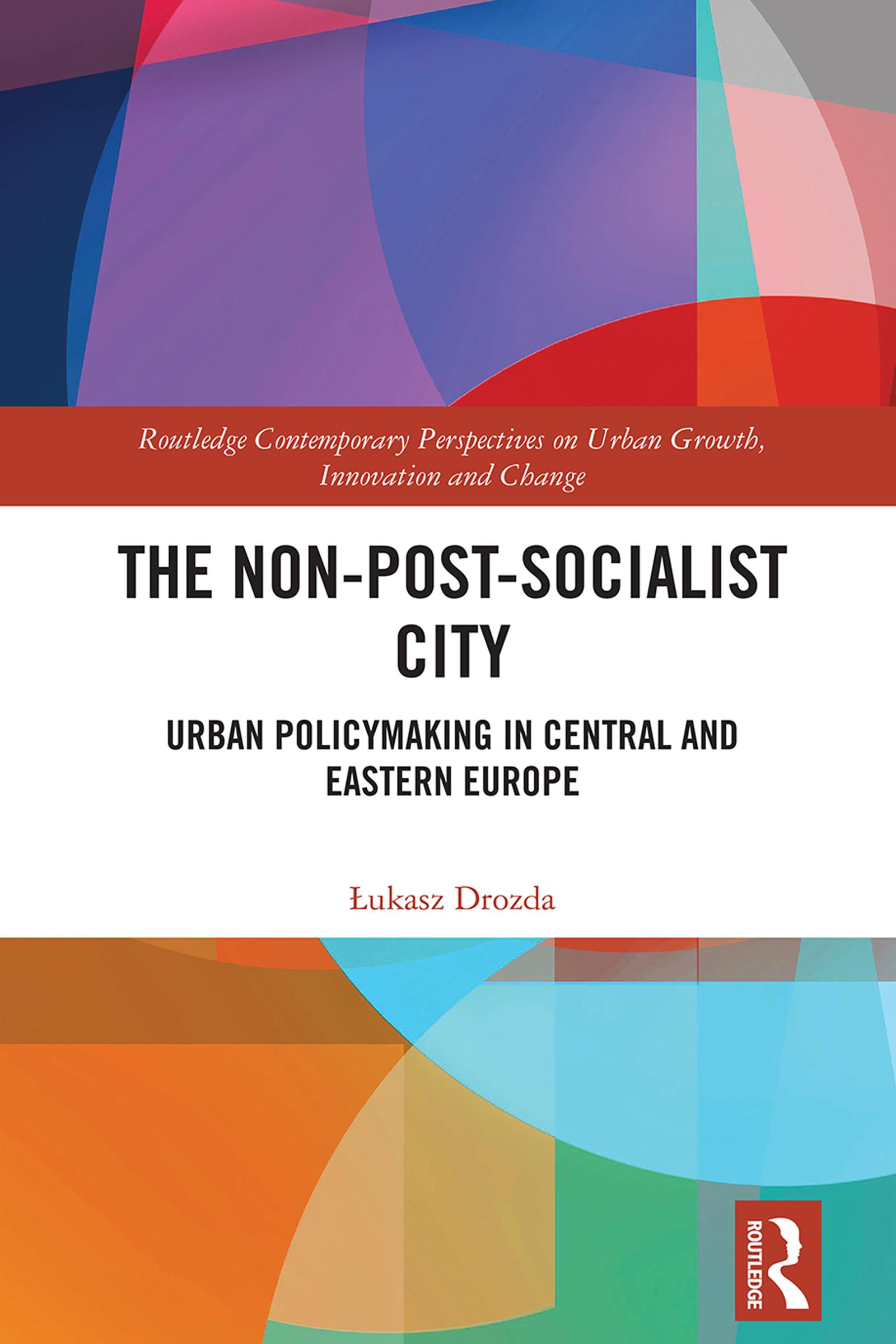
The Non-Post-Socialist City examines contemporary urban policies through case studies of six cities in four states across Central and Eastern Europe and Former Soviet Union (CEE/FSU) region.
This book adopts a rarely used approach in the study of so-called post-socialist cities—combining several years of in-depth empirical research with a broad comparative frame. Building on this foundation, it analyzes urban policymaking processes in Leipzig (Germany), Warsaw and Krakow (Poland), Tallinn (Estonia), and Kyiv and Lviv (Ukraine). The monograph interprets these dynamics through the author’s concept of diluted post-socialism, which highlights not only trajectories rooted in the Soviet-dominated era but also a range of pre- or nonsocialist legacies that interact with—and often complicate—the few decades of now-defunct state-socialist rule. Particular attention is given to four policy fields: mobility, green infrastructure, housing, and spatial planning. While these domains pose broadly similar dimensions across the six cities, their organization reveals a highly diverse urban landscape that is too often flattened under the “post-socialist” label.
The book is intended for scholars, analysts, students, and anyone interested in urbanization processes in the former Eastern bloc, as well as in the impact of the global populist turn on urban policymaking within this region and in a broader urban context.
Paga fácilmente con tarjeta, Klarna, Apple Pay o Google Pay. ¿No estás contento? Siempre tienes 14 días de garantía de devolución. Lee más en nuestros términos. Si tienes preguntas, escríbenos a hello@memmo.org.
Memmo hace que estudiar sea más fácil, estés donde estés. Aquí tienes tus libros de texto y herramientas de estudio inteligentes en un solo lugar: resúmenes, quizzes, podcasts y flashcards. Y también a Ted, tu compañero de estudio que responde a todo lo que te preguntes. Más de 50 000 estudiantes ya estudian aquí. Está hecho para que aprendas más rápido y te estreses menos.