
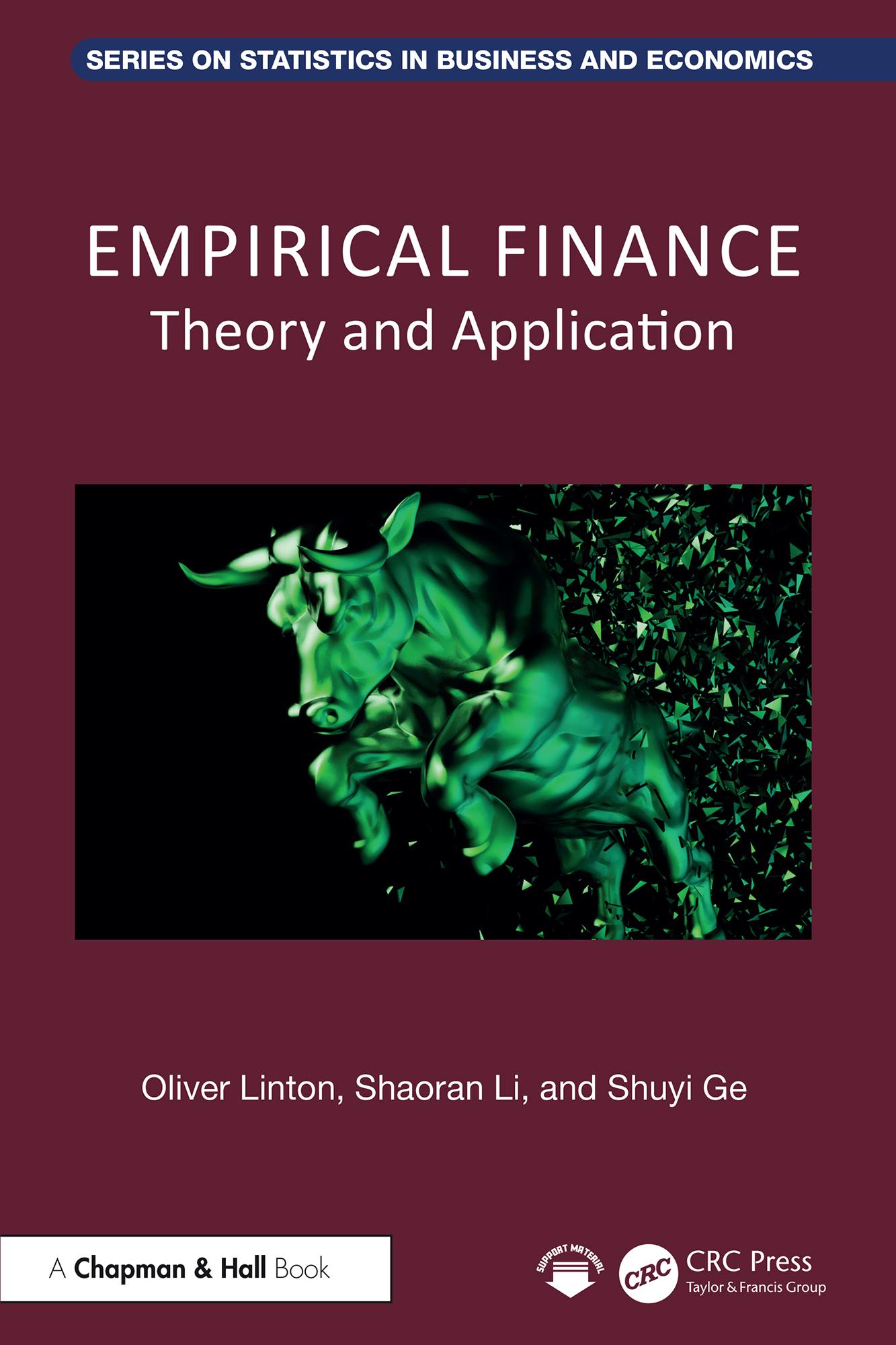
Empirical Finance: Theory and Application offers a modern, data-driven introduction to the field of finance, tailored for undergraduate students and practitioners seeking to bridge theory with real-world evidence. In an era defined by abundant data and computational power, this book emphasizes hands-on learning by integrating financial theory, empirical analysis, and practical implementation using Python and R. Each chapter balances intuitive explanations with mathematical rigor, ensuring that readers not only understand key concepts but also learn how to test them with actual data.
Structured in two parts, the book begins with a thorough review of essential quantitative tools—optimization, probability, and statistics—providing the foundation needed for empirical work. The second part applies these tools to core topics in finance, including asset pricing, portfolio choice, market efficiency, event studies, and volatility modeling. Real-world examples and case studies—such as testing the Efficient Markets Hypothesis, analyzing stock splits, and evaluating the equity premium—bring the material to life and illustrate how empirical methods can validate or challenge economic intuition.
A distinctive feature of this text is its emphasis on reproducibility and application. Code snippets, exercises, and datasets enable readers to replicate results and develop their own analyses. Topics like time-series properties of returns, portfolio management and behavioral finance are treated with both theoretical and empirical depth, preparing students for quantitative internships, graduate studies, or roles in the financial industry.
Ideal for courses in Empirical Finance, Financial Econometrics, or Quantitative Finance, this book stands out for its clear exposition, relevance to contemporary practice, and commitment to evidence-based reasoning. It empowers a new generation of finance students to think critically, work with data, and understand markets not as a set of abstract rules, but as a dynamic interplay of economics, data, and technology.
Key Features:
· Seamlessly integrates hands-on coding in both Python and R with financial theory, enabling readers to replicate results and conduct their own empirical analysis.
· Strikes a unique balance between financial intuition, mathematical clarity, and real-world application, avoiding the common extremes of abstract theory or mere data manipulation.
· Structured in two distinct parts—first building essential quantitative tools (optimization, probability, statistics) before applying them to core finance topics—ensuring a solid foundation for empirical work.
· Uses contemporary, relevant examples throughout, such as testing market anomalies, analyzing cryptocurrency returns, and conducting event studies on recent scandals.
· Emphasizes a data-centric approach to validate or challenge economic reasoning, teaching students to treat finance as a dynamic, evidence-based discipline.
Paga fácilmente con tarjeta, Klarna, Apple Pay o Google Pay. ¿No estás contento? Siempre tienes 14 días de garantía de devolución. Lee más en nuestros términos. Si tienes preguntas, escríbenos a hello@memmo.org.
Memmo hace que estudiar sea más fácil, estés donde estés. Aquí tienes tus libros de texto y herramientas de estudio inteligentes en un solo lugar: resúmenes, quizzes, podcasts y flashcards. Y también a Ted, tu compañero de estudio que responde a todo lo que te preguntes. Más de 50 000 estudiantes ya estudian aquí. Está hecho para que aprendas más rápido y te estreses menos.