
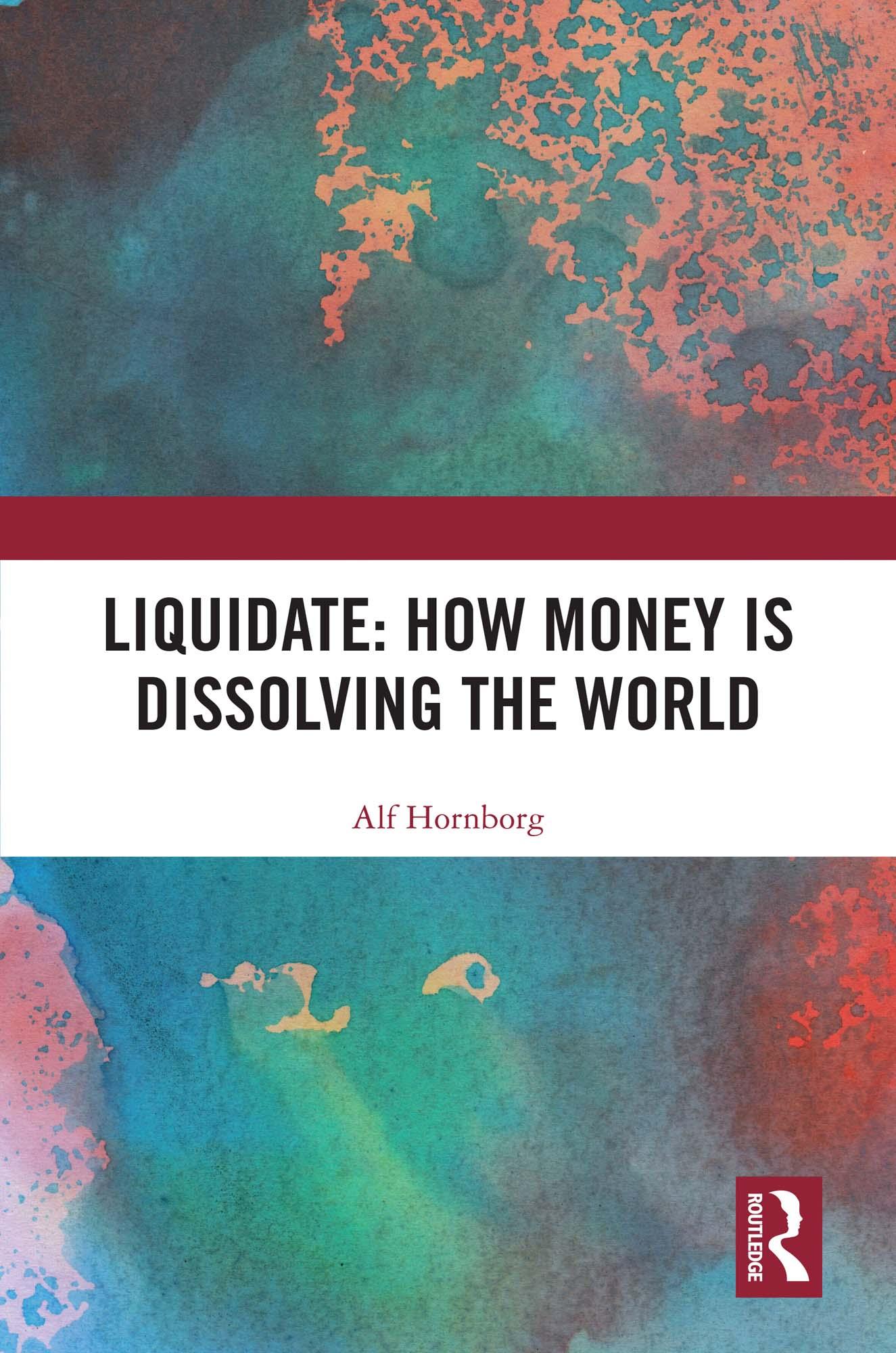
Liquidate: How Money is Dissolving the World examines the emergence of money and its social and ecological repercussions. It views money as a new phenomenon in the evolution of life that has fundamentally transformed ecosystems and human social relations.
The appearance of coined money around 600 BCE coincided with the first abstract philosophies and religions. This book shows how changes in human–environmental relations have reflected changes in social relations generated by money. The detached modern view of nature mirrors the socially detached modern individual. However, the abandonment of animism has not diminished the human propensity for fetishism – the perception of artefacts such as money tokens as indexes of what they represent. Market prices obscure the asymmetric global resource transfers that make increasingly advanced technologies possible where there is enough money. Our fetishised understandings of money and technologies cannot deal with the escalating production of entropy underlying climate change. They also drive the dramatic reduction of biological and cultural diversity under globalisation. Given these problems, many people reassess premodern and indigenous societies in search of more sustainable ideas on how to organise exchange.
Liquidate: How Money is Dissolving the World will be of interest to scholars working in anthropology, sociology, economics, history, semiotics, comparative religions, and indigenous studies.
Paga fácilmente con tarjeta, Klarna, Apple Pay o Google Pay. ¿No estás contento? Siempre tienes 14 días de garantía de devolución. Lee más en nuestros términos. Si tienes preguntas, escríbenos a hello@memmo.org.
Memmo hace que estudiar sea más fácil, estés donde estés. Aquí tienes tus libros de texto y herramientas de estudio inteligentes en un solo lugar: resúmenes, quizzes, podcasts y flashcards. Y también a Ted, tu compañero de estudio que responde a todo lo que te preguntes. Más de 50 000 estudiantes ya estudian aquí. Está hecho para que aprendas más rápido y te estreses menos.