
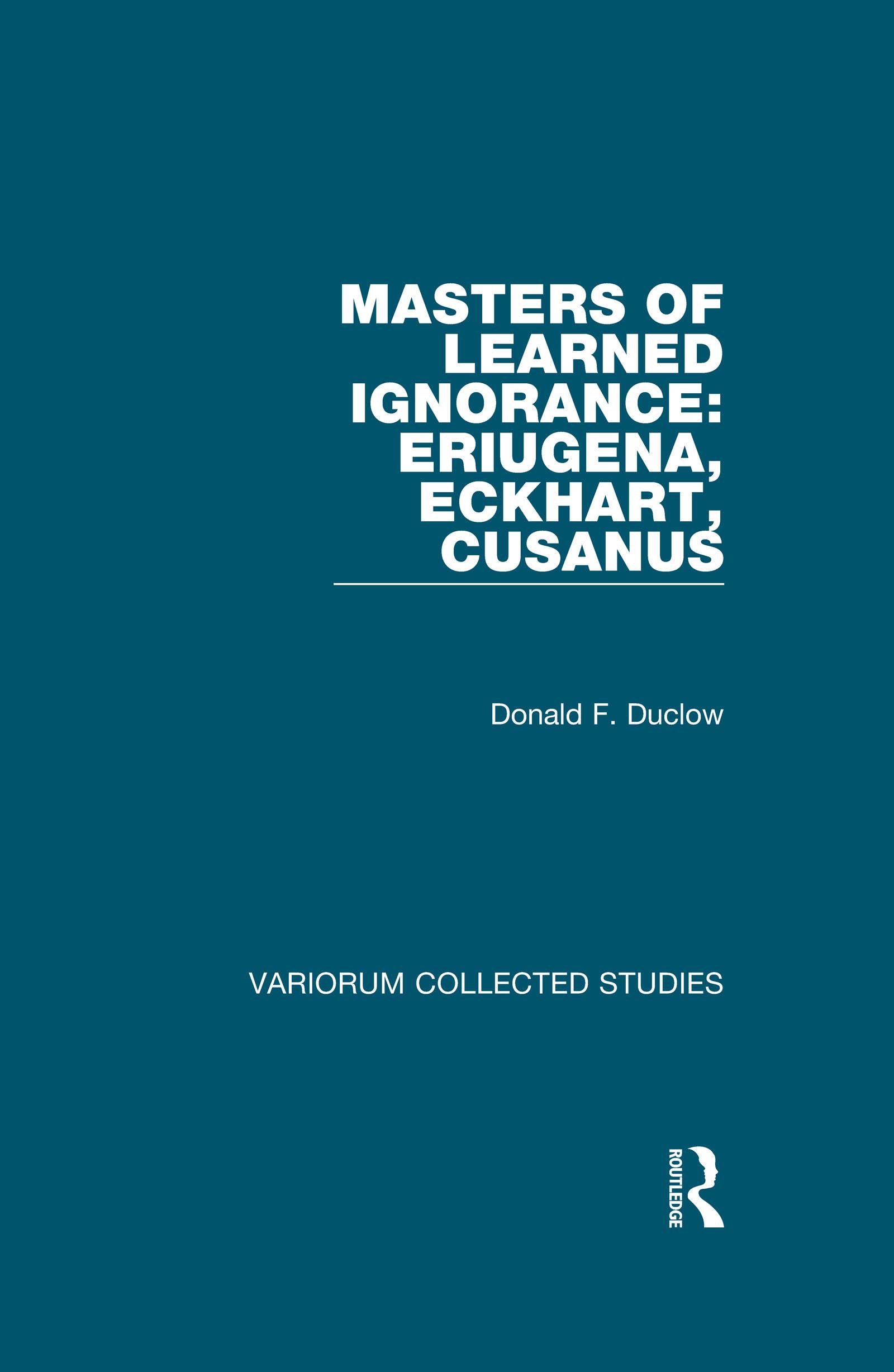
The medieval Christian West's most radical practitioners of a Neoplatonic, negative theology with a mystical focus are John Scottus Eriugena, Meister Eckhart and Nicholas Cusanus. All three mastered what Cusanus described as docta ignorantia: reflecting on their awareness that they could know neither God nor the human mind, they worked out endlessly varied attempts to express what cannot be known. Following Pseudo-Dionysius the Areopagite, they sought to name God with symbolic expressions whose negation leads into mystical theology. For within their Neoplatonic dialectic, negation moves beyond reason and its finite distinctions to intellect, where opposites coincide and a vision of God's infinite unity becomes possible. In these papers Duclow views these thinkers' efforts through the lens of contemporary philosophical hermeneutics. He highlights the interplay of creativity, symbolic expression and language, interpretation and silence as Eriugena, Eckhart and Cusanus comment on the mind's work in naming God. This work itself becomes mystical theology when negation opens into a silent awareness of God's presence, from which the Word once again 'speaks' within the mind - and renews the process of creating and interpreting symbols. Comparative studies with Gregory of Nyssa, Pseudo-Dionysius, Anselm and Hadewijch suggest the book's wider implications for medieval philosophy and theology.
Paga fácilmente con tarjeta, Klarna, Apple Pay o Google Pay. ¿No estás contento? Siempre tienes 14 días de garantía de devolución. Lee más en nuestros términos. Si tienes preguntas, escríbenos a hello@memmo.org.
Memmo hace que estudiar sea más fácil, estés donde estés. Aquí tienes tus libros de texto y herramientas de estudio inteligentes en un solo lugar: resúmenes, quizzes, podcasts y flashcards. Y también a Ted, tu compañero de estudio que responde a todo lo que te preguntes. Más de 50 000 estudiantes ya estudian aquí. Está hecho para que aprendas más rápido y te estreses menos.
También te podría gustar
Comprar el libro0