
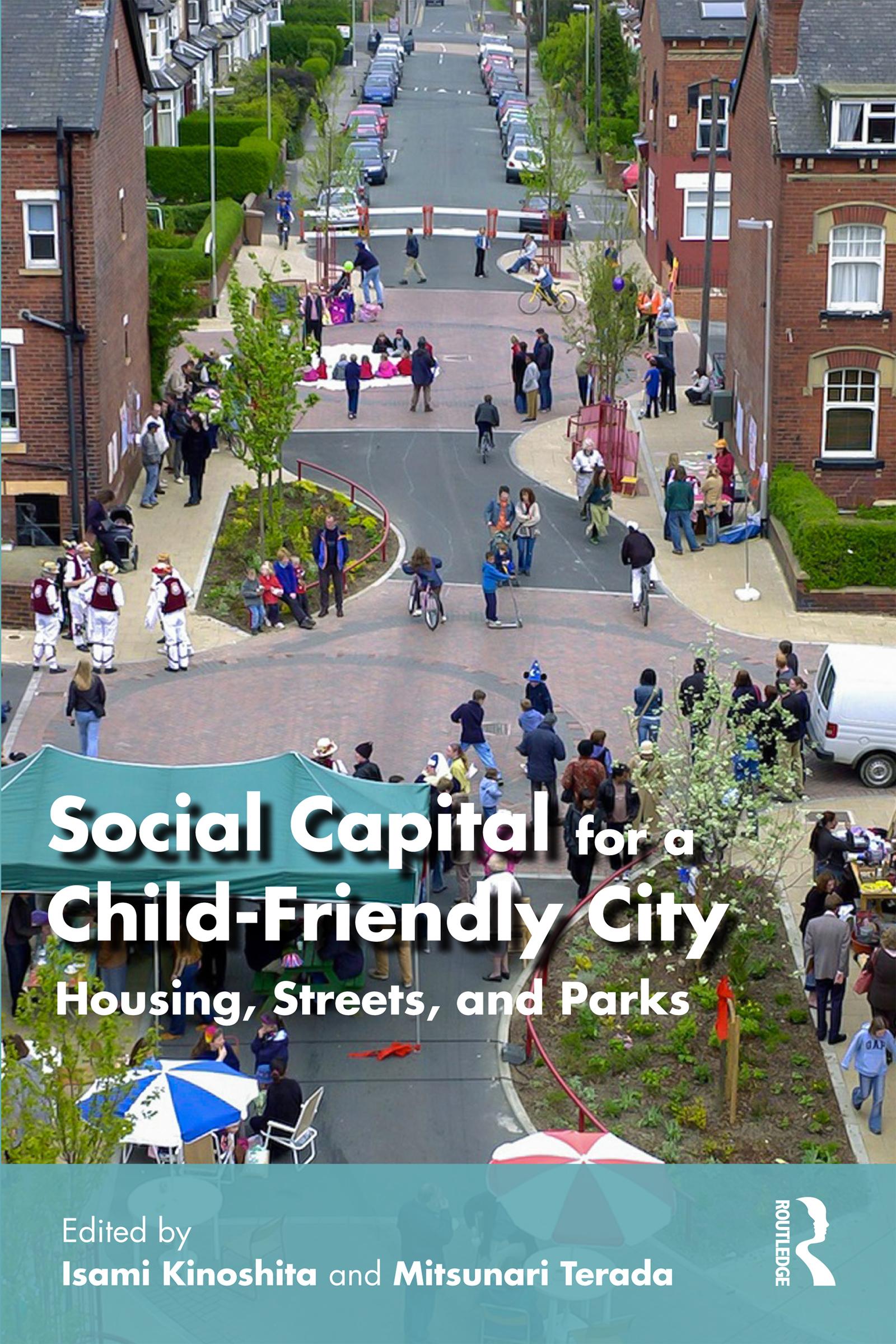
Social Capital for a Child-Friendly City argues for the importance of relationship networks (social capital) in children’s growth and socialization, and explores how child-friendly social capital can be cultivated through urban planning and community development. As outdoor play decreases and children spend more time online, Kinoshita and Terada return to John Dewey’s proposal that social capital is essential for nurturing the next generation and establish a democratic and sustainable society. The book features examples from Sweden, Finland, Germany, Switzerland, the UK, and Japan, exploring methods for cultivating social capital and spaces for children to play and develop in cooperative housing, outdoor play spaces, streets, parks, and neighbourhoods. We express our gratitude to Dr. Marketta Kytta, Professor of Aalto University, who gave valuable suggestions about the key term ‘bullerby’ and ‘social capital’.
This book will be of use to students and practitioners of urban planning and landscape architecture, as well as any community leaders or developers seeking to foster a nurturing environment where children can flourish.
Paga fácilmente con tarjeta, Klarna, Apple Pay o Google Pay. ¿No estás contento? Siempre tienes 14 días de garantía de devolución. Lee más en nuestros términos. Si tienes preguntas, escríbenos a hello@memmo.org.
Memmo hace que estudiar sea más fácil, estés donde estés. Aquí tienes tus libros de texto y herramientas de estudio inteligentes en un solo lugar: resúmenes, quizzes, podcasts y flashcards. Y también a Ted, tu compañero de estudio que responde a todo lo que te preguntes. Más de 50 000 estudiantes ya estudian aquí. Está hecho para que aprendas más rápido y te estreses menos.