
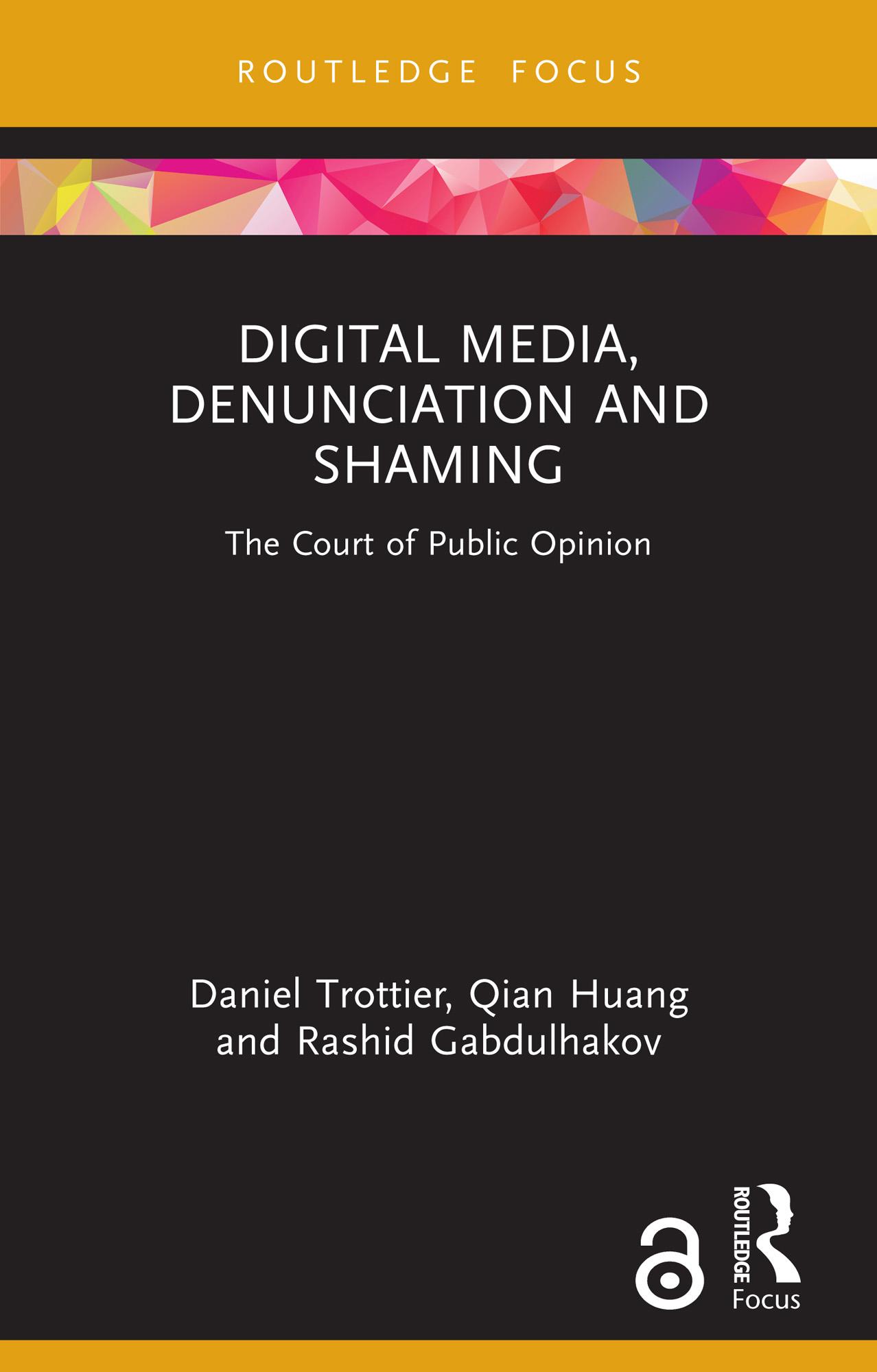
This book offers a common set of concepts to help make sense of online shaming practices, accounting for instances of discrimination and injury that morally divide readers and at times risk unjust and disproportionate harm to those under scrutiny.
Digital media denunciation has become a primary form of expression and entertainment across media environments, with new socially desirable forms of accountability under movements such as #MeToo and #BlackLivesMatter addressing longstanding forms of systematic and interpersonal abuse. Building on recent scholarship on shaming, surveillance and denunciation in fixed contexts, this study generates a cross-contextual and multi-actor account of practices like ‘cancel culture’, ‘doxing’ and ‘status degradation ceremonies’. It addresses instances of moral ambivalence by discussing how digital shaming becomes normalised and embedded across socio-cultural and institutional settings. The authors establish key actors and practices in online denunciations of individuals in a range of cases and contexts, including responses to COVID-19, political polarisation, and social justice movements, as well as more local and quotidian circumstances. They draw from empirical data including interviews with nearly 100 individuals targeted by mediated shaming and/or involved in these practices, as well as ethnographic observations of digital vigilantism and discourse analysis of press coverage and online comments relating to online shaming. Diverse applications and contexts, including China, the UK, Russia, and Central Asia, are considered, advancing an ambivalent understanding of media and denunciation that reconciles progressive and regressive practices, as well as celebratory and critical accounts of these practices.
This book is recommended reading for advanced students and researchers of online visibility and harm across media studies, cultural studies and sociology.
The Open Access version of this book, available at http://www.taylorfrancis.com, has been made available under a Creative Commons Attribution-Non Commercial-No Derivatives (CC-BY-NC-ND) 4.0 license.
This research was funded by the Dutch Research Council (NWO), project number 276-45-004 and file number 36.201.097.
Paga fácilmente con tarjeta, Klarna, Apple Pay o Google Pay. ¿No estás contento? Siempre tienes 14 días de garantía de devolución. Lee más en nuestros términos. Si tienes preguntas, escríbenos a hello@memmo.org.
Memmo hace que estudiar sea más fácil, estés donde estés. Aquí tienes tus libros de texto y herramientas de estudio inteligentes en un solo lugar: resúmenes, quizzes, podcasts y flashcards. Y también a Ted, tu compañero de estudio que responde a todo lo que te preguntes. Más de 50 000 estudiantes ya estudian aquí. Está hecho para que aprendas más rápido y te estreses menos.