
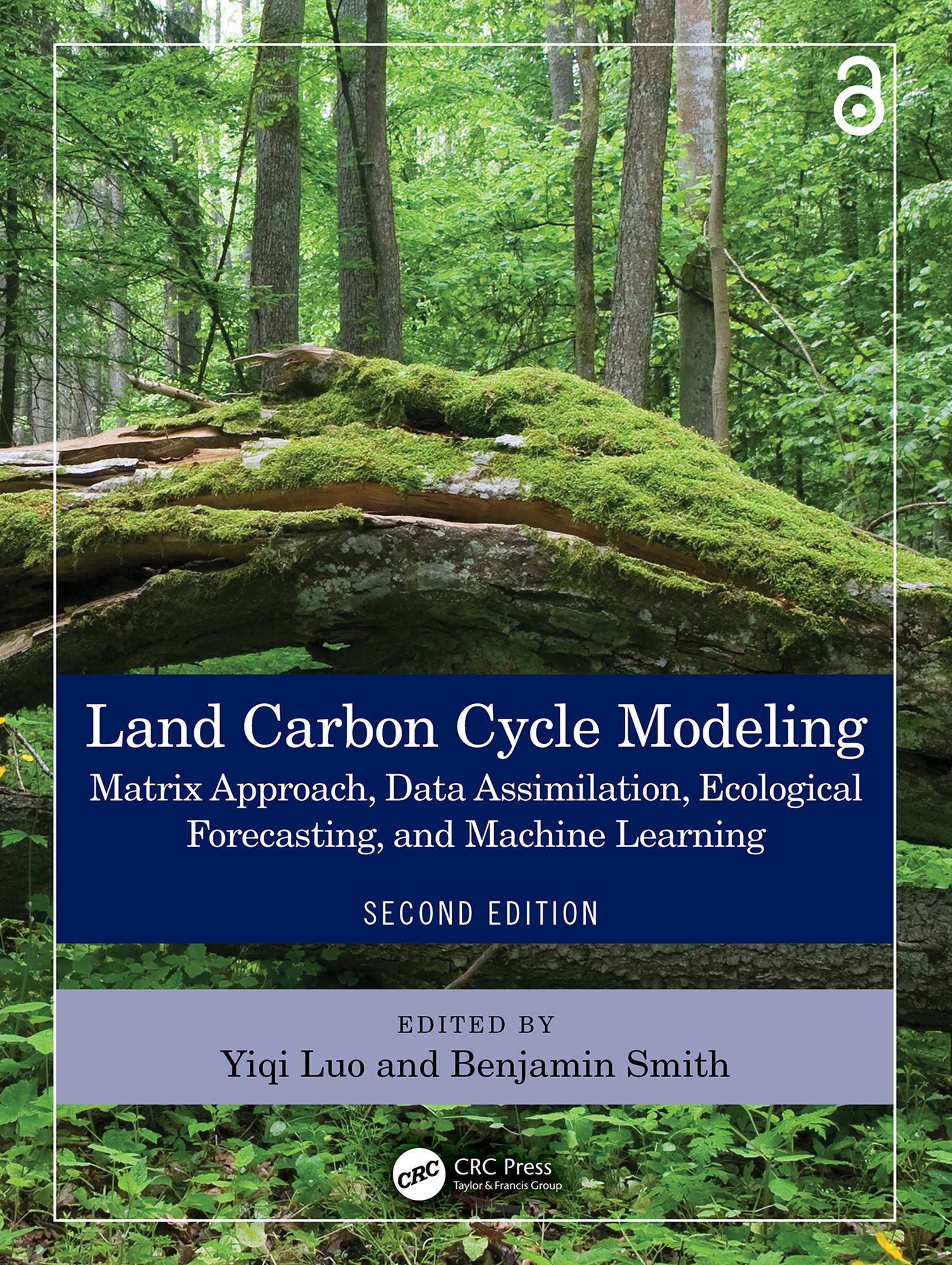
Carbon moves through the atmosphere, through the oceans, onto land, and into ecosystems. This cycling has a large effect on climate – changing geographic patterns of rainfall and the frequency of extreme weather – and is altered as the use of fossil fuels adds carbon to the cycle. The dynamics of this global carbon cycling are largely predicted over broad spatial scales and long periods of time by Earth system models. This book addresses the crucial question of how to assess, evaluate, and estimate the potential impact of the additional carbon to the land carbon cycle. The contributors describe a set of new approaches to land carbon cycle modeling for better exploring ecological questions regarding changes in carbon cycling; employing data assimilation techniques for model improvement; doing real- or near-time ecological forecasting for decision support; and combining newly available machine learning techniques with process-based models to improve prediction of the land carbon cycle under climate change. This new edition includes seven new chapters: machine learning and its applications to carbon cycle research (five chapters); principles underlying carbon dioxide removal from the atmosphere, contemporary active research and management issues (one chapter); and community infrastructure for ecological forecasting (one chapter).
Key Features
- Helps readers understand, implement, and criticize land carbon cycle models
- Offers a new theoretical framework to understand transient dynamics of the land carbon cycle
- Describes a suite of modeling skills – matrix approach to represent land carbon, nitrogen, and phosphorus cycles; data assimilation and machine learning to improve parameterization; and workflow systems to facilitate ecological forecasting
- Introduces a new set of techniques, such as semi-analytic spin-up (SASU), unified diagnostic system with a 1-3-5 scheme, traceability analysis, and benchmark analysis, and PROcess-guided machine learning and DAta-driven modeling (PRODA) for model evaluation and improvement
- Reorganized from the first edition with seven new chapters added
- Strives to balance theoretical considerations, technical details, and applications of ecosystem modeling for research, assessment, and crucial decision-making
Paga fácilmente con tarjeta, Klarna, Apple Pay o Google Pay. ¿No estás contento? Siempre tienes 14 días de garantía de devolución. Lee más en nuestros términos. Si tienes preguntas, escríbenos a hello@memmo.org.
Memmo hace que estudiar sea más fácil, estés donde estés. Aquí tienes tus libros de texto y herramientas de estudio inteligentes en un solo lugar: resúmenes, quizzes, podcasts y flashcards. Y también a Ted, tu compañero de estudio que responde a todo lo que te preguntes. Más de 50 000 estudiantes ya estudian aquí. Está hecho para que aprendas más rápido y te estreses menos.