
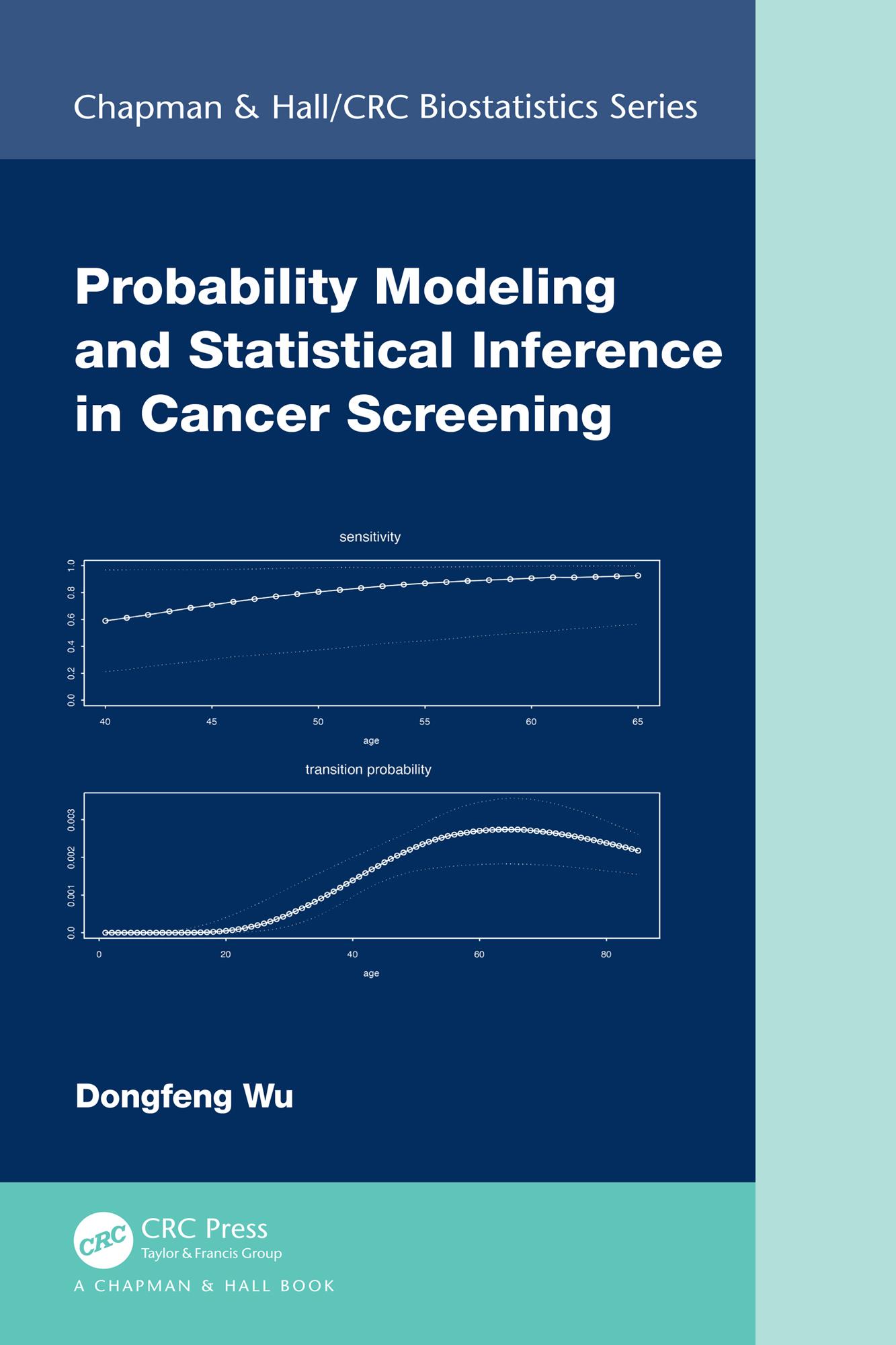
Cancer screening has been carried out for six decades – however, there are many unsolved problems: how to estimate key parameters involved in screenings, such as sensitivity, the time duration in the preclinical state (i.e., sojourn time), and time duration in the disease-free state; how to estimate the distribution of lead time, the diagnosis time advanced by screening; how to evaluate the long-term outcomes of screening, including the probability of overdiagnosis among the screen-detected; when to schedule the first exam based on one’s current age and risk tolerance; and when to schedule the upcoming exam based on one’s screening history, age, and risk tolerance. These problems need proper probability models and statistical methods in order to be dealt with.
Features:
- This book gives a concise account of the analysis of cancer screening data, using probability models and statistical methods.
- Real data sets are provided so that cancer researchers and statisticians can apply the methods in the learning process.
- It develops statistical methods in the commonly used disease progressive model.
- It provides solutions to practical problems and introduces open problems.
- It provides a framework for the most recent developments based on the author’s research.
The book is primarily aimed at researchers and practitioners from biostatistics and cancer research. Readers should have the prerequisite knowledge of calculus, probability, and statistical inference. The book could be used as a one-semester textbook on the topic of cancer screening methodology for a graduate-level course.
Paga fácilmente con tarjeta, Klarna, Apple Pay o Google Pay. ¿No estás contento? Siempre tienes 14 días de garantía de devolución. Lee más en nuestros términos. Si tienes preguntas, escríbenos a hello@memmo.org.
Memmo hace que estudiar sea más fácil, estés donde estés. Aquí tienes tus libros de texto y herramientas de estudio inteligentes en un solo lugar: resúmenes, quizzes, podcasts y flashcards. Y también a Ted, tu compañero de estudio que responde a todo lo que te preguntes. Más de 50 000 estudiantes ya estudian aquí. Está hecho para que aprendas más rápido y te estreses menos.