
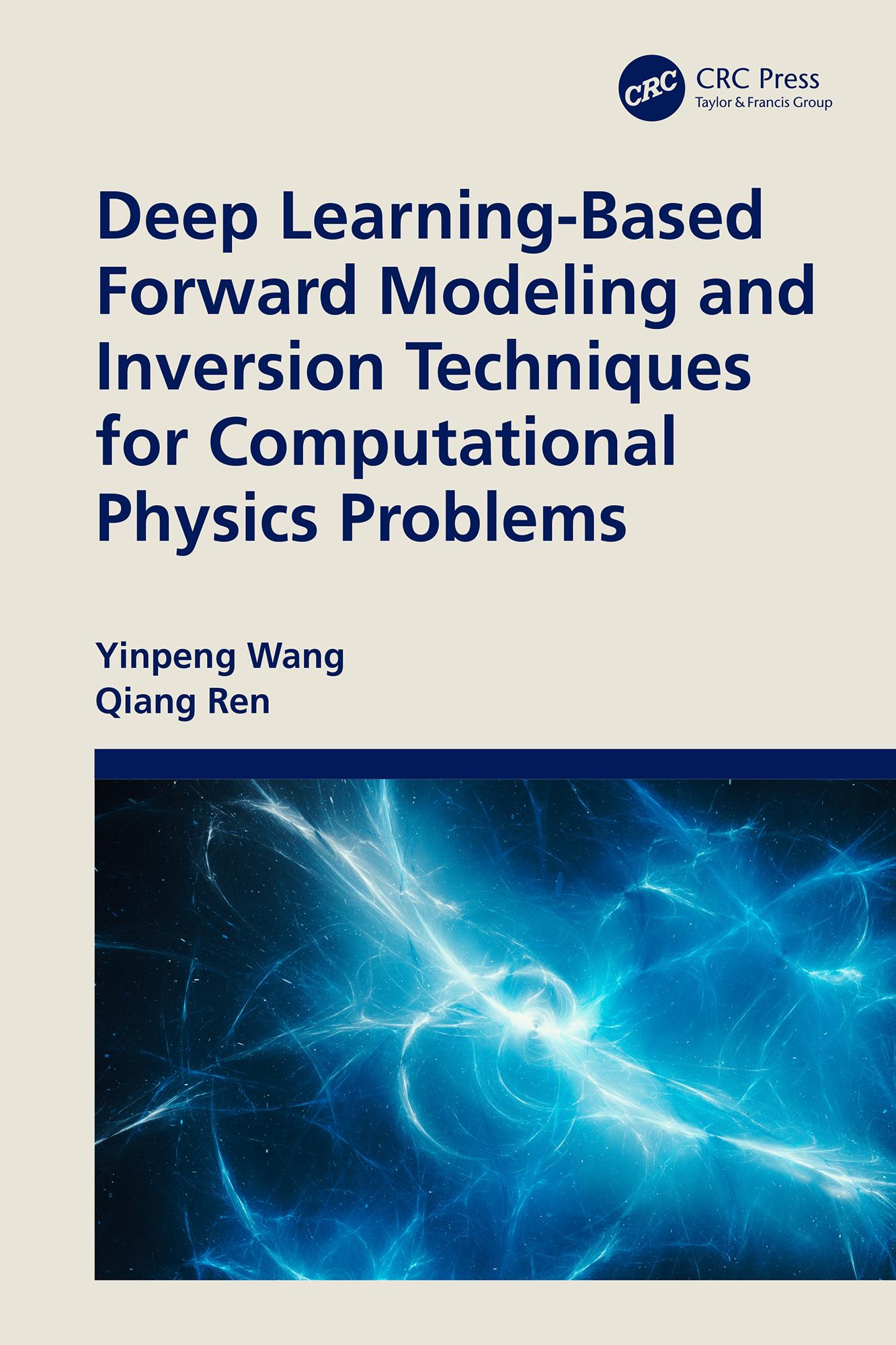
This book investigates in detail the emerging deep learning (DL) technique in computational physics, assessing its promising potential to substitute conventional numerical solvers for calculating the fields in real-time. After good training, the proposed architecture can resolve both the forward computing and the inverse retrieve problems.
Pursuing a holistic perspective, the book includes the following areas. The first chapter discusses the basic DL frameworks. Then, the steady heat conduction problem is solved by the classical U-net in Chapter 2, involving both the passive and active cases. Afterwards, the sophisticated heat flux on a curved surface is reconstructed by the presented Conv-LSTM, exhibiting high accuracy and efficiency. Additionally, a physics-informed DL structure along with a nonlinear mapping module are employed to obtain the space/temperature/time-related thermal conductivity via the transient temperature in Chapter 4. Finally, in Chapter 5, a series of the latest advanced frameworks and the corresponding physics applications are introduced.
As deep learning techniques are experiencing vigorous development in computational physics, more people desire related reading materials. This book is intended for graduate students, professional practitioners, and researchers who are interested in DL for computational physics.
Paga fácilmente con tarjeta, Klarna, Apple Pay o Google Pay. ¿No estás contento? Siempre tienes 14 días de garantía de devolución. Lee más en nuestros términos. Si tienes preguntas, escríbenos a hello@memmo.org.
Memmo hace que estudiar sea más fácil, estés donde estés. Aquí tienes tus libros de texto y herramientas de estudio inteligentes en un solo lugar: resúmenes, quizzes, podcasts y flashcards. Y también a Ted, tu compañero de estudio que responde a todo lo que te preguntes. Más de 50 000 estudiantes ya estudian aquí. Está hecho para que aprendas más rápido y te estreses menos.