
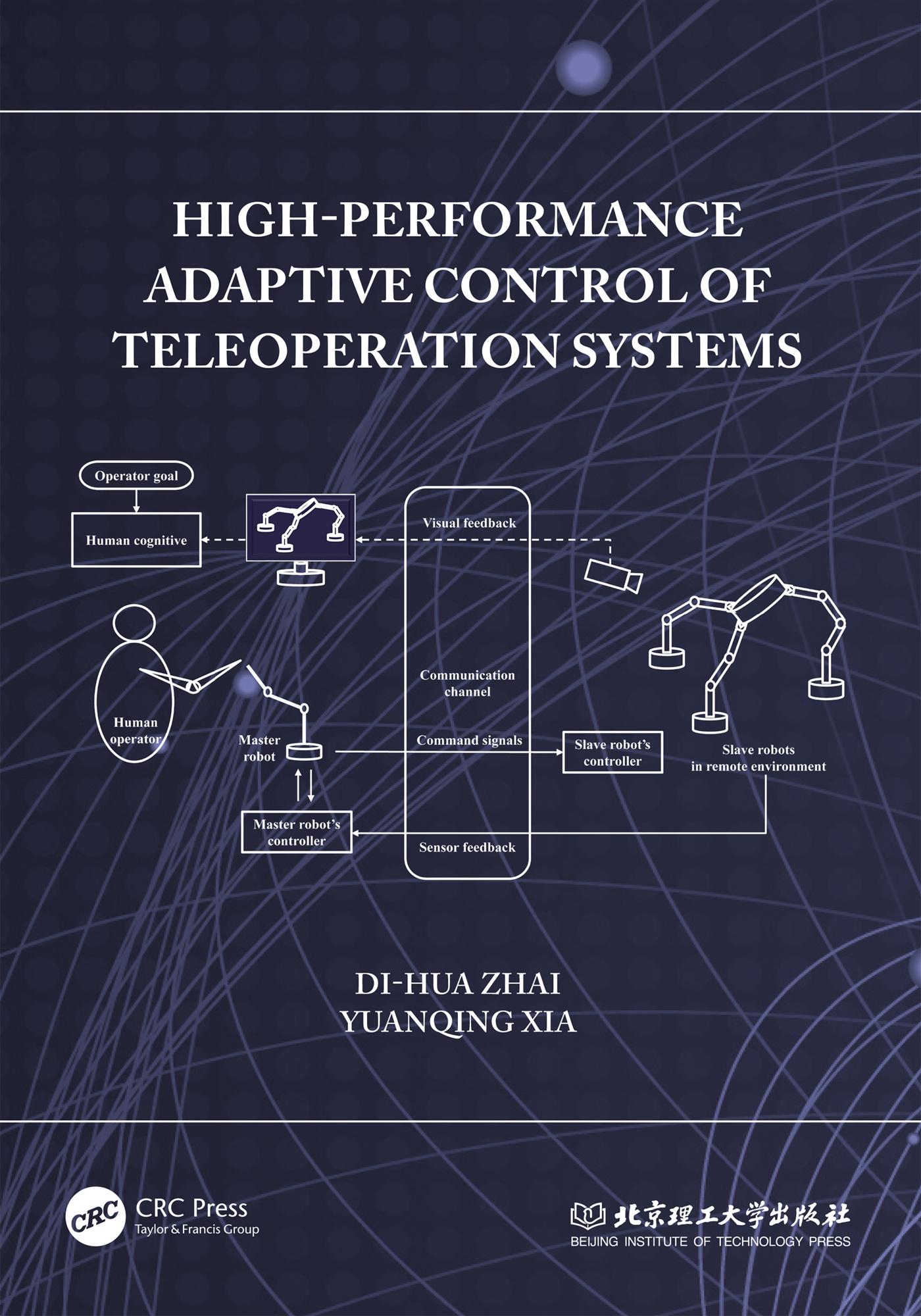
Within a unified switched-control framework, this book investigates the high-performance control designs and theoretic analyses for teleoperation systems, including the joint space and task space teleoperations, the homogeneous and heterogeneous teleoperations, and the single-master single-slave and multi-master multi-slave teleoperations.
The book begins with an introduction to the concepts and challenges of networked teleoperation systems. Then, it investigates a new adaptive control framework based on auxiliary switched filters for the bilateral teleoperation systems to handle the model uncertainty and non-passive external forces. To overcome the input constraints of robotic systems, this adaptive method is also extended to the anti-windup adaptive control case. Furthermore, to apply to multi-robot remote collaboration scenarios and heterogeneous teleoperations, two tele-coordination methods and an adaptive semi-autonomous control method are respectively developed. Finally, the authors examine two finite-time control schemes and two types of improved prescribed performance controls for teleoperation systems to improve the transient-state and steady-state synchronization performances.
This title will be an essential reference for researchers and engineers interested in teleoperation, robotic systems, and nonlinear control systems. It would also prove useful to graduate students in the fields of science, engineering, and computer science.
Paga fácilmente con tarjeta, Klarna, Apple Pay o Google Pay. ¿No estás contento? Siempre tienes 14 días de garantía de devolución. Lee más en nuestros términos. Si tienes preguntas, escríbenos a hello@memmo.org.
Memmo hace que estudiar sea más fácil, estés donde estés. Aquí tienes tus libros de texto y herramientas de estudio inteligentes en un solo lugar: resúmenes, quizzes, podcasts y flashcards. Y también a Ted, tu compañero de estudio que responde a todo lo que te preguntes. Más de 50 000 estudiantes ya estudian aquí. Está hecho para que aprendas más rápido y te estreses menos.