
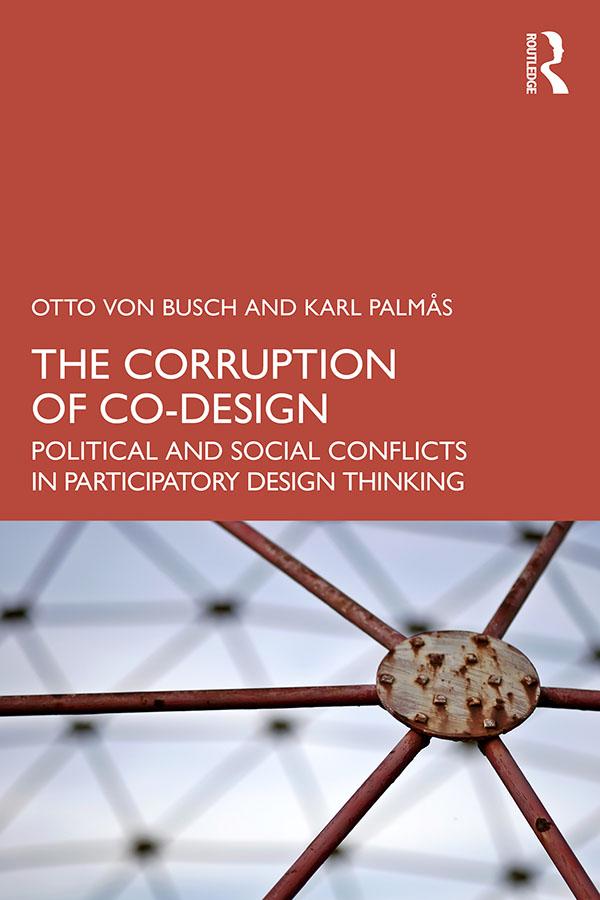
Designers are often depicted as social change agents that serve the good in the world. Similarly, co-design tends to be described as a democratic mode of creativity that is somehow beyond reproach. But is change a virtue in itself, and do participatory practices always produce socially beneficial outcomes?
Such questions are becoming more pressing as co-design has emerged as a dominant practice in planning and urban design, while also informing corporate management and public administration. In this book, Otto von Busch and Karl Palmås suggest that designers tend to overemphasize the place of ideals in design, leaving them ill-equipped to deal with a social world of power-wielding and zero-sum games. Seeking to reorient the concerns of the Scandinavian tradition of participatory design, they suggest that co-design processes are rife with betrayals, decay, and corruption, and that designerly empathy has morphed into a new form of cunning statecraft.
In putting forward Realdesign as an alternative conception of design practice, von Busch and Palmås ask: What hard lessons about the social must today’s designers learn from realists like Machiavelli?
Paga fácilmente con tarjeta, Klarna, Apple Pay o Google Pay. ¿No estás contento? Siempre tienes 14 días de garantía de devolución. Lee más en nuestros términos. Si tienes preguntas, escríbenos a hello@memmo.org.
Memmo hace que estudiar sea más fácil, estés donde estés. Aquí tienes tus libros de texto y herramientas de estudio inteligentes en un solo lugar: resúmenes, quizzes, podcasts y flashcards. Y también a Ted, tu compañero de estudio que responde a todo lo que te preguntes. Más de 50 000 estudiantes ya estudian aquí. Está hecho para que aprendas más rápido y te estreses menos.