
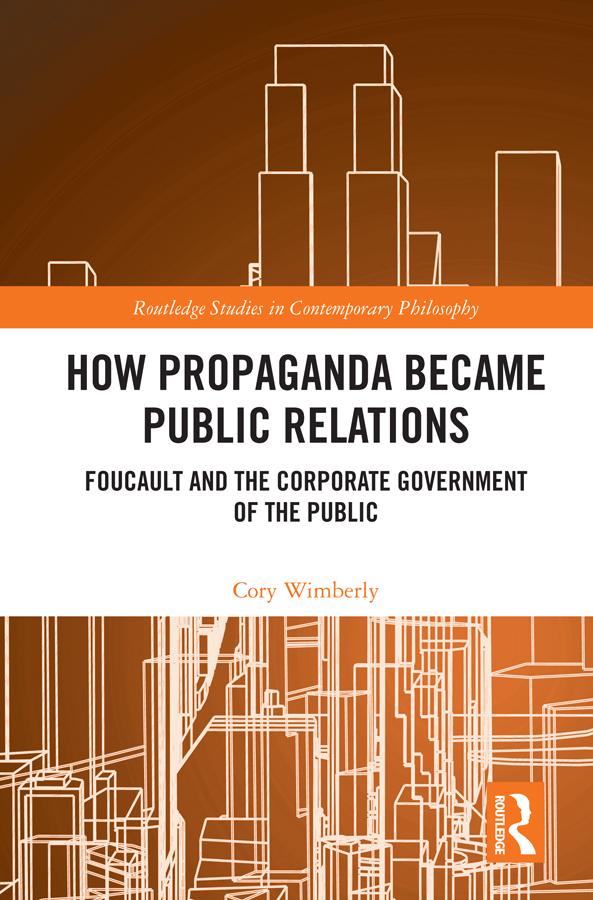
How Propaganda Became Public Relations pulls back the curtain on propaganda: how it was born, how it works, and how it has masked the bulk of its operations by rebranding itself as public relations. Cory Wimberly uses archival materials and wide variety of sources — Foucault’s work on governmentality, political economy, liberalism, mass psychology, and history — to mount a genealogical challenge to two commonplaces about propaganda. First, modern propaganda did not originate in the state and was never primarily located in the state; instead, it began and flourished as a for-profit service for businesses. Further, propaganda is not focused on public beliefs and does not operate mainly through lies and deceit; propaganda is an apparatus of government that aims to create the publics that will freely undertake the conduct its clients’ desire.
Businesses have used propaganda since the early twentieth century to construct the laboring, consuming, and voting publics that they needed to secure and grow their operations. Over that time, corporations have become the most numerous and well-funded apparatuses of government in the West, operating privately and without democratic accountability. Wimberly explains why liberal strategies of resistance have failed and a new focus on creating mass subjectivity through democratic means is essential to countering propaganda.
This book offers a sophisticated analysis that will be of interest to scholars and advanced students working in social and political philosophy, Continental philosophy, political communication, the history of capitalism, and the history of public relations.
Paga fácilmente con tarjeta, Klarna, Apple Pay o Google Pay. ¿No estás contento? Siempre tienes 14 días de garantía de devolución. Lee más en nuestros términos. Si tienes preguntas, escríbenos a hello@memmo.org.
Memmo hace que estudiar sea más fácil, estés donde estés. Aquí tienes tus libros de texto y herramientas de estudio inteligentes en un solo lugar: resúmenes, quizzes, podcasts y flashcards. Y también a Ted, tu compañero de estudio que responde a todo lo que te preguntes. Más de 50 000 estudiantes ya estudian aquí. Está hecho para que aprendas más rápido y te estreses menos.