
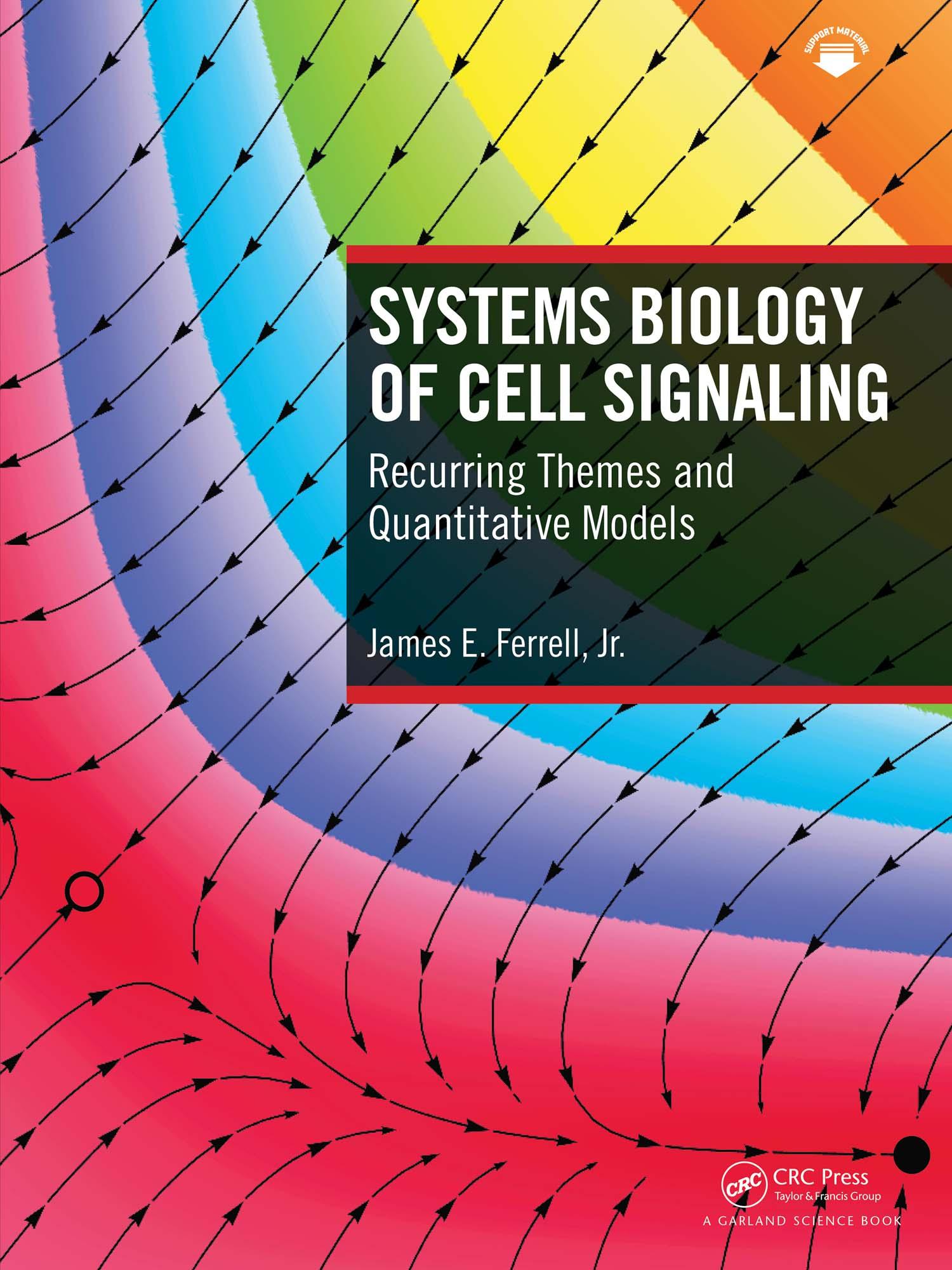
How can we understand the complexity of genes, RNAs, and proteins and the associated regulatory networks? One approach is to look for recurring types of dynamical behavior. Mathematical models prove to be useful, especially models coming from theories of biochemical reactions such as ordinary differential equation models. Clever, careful experiments test these models and their basis in specific theories. This textbook aims to provide advanced students with the tools and insights needed to carry out studies of signal transduction drawing on modeling, theory, and experimentation. Early chapters summarize the basic building blocks of signaling systems: binding/dissociation, synthesis/destruction, and activation/inactivation. Subsequent chapters introduce various basic circuit devices: amplifiers, stabilizers, pulse generators, switches, stochastic spike generators, and oscillators. All chapters consistently use approaches and concepts from chemical kinetics and nonlinear dynamics, including rate-balance analysis, phase plane analysis, nullclines, linear stability analysis, stable nodes, saddles, unstable nodes, stable and unstable spirals, and bifurcations. This textbook seeks to provide quantitatively inclined biologists and biologically inclined physicists with the tools and insights needed to apply modeling and theory to interesting biological processes.
Key Features:
- Full-color illustration program with diagrams to help illuminate the concepts
- Enables the reader to apply modeling and theory to the biological processes
- Further Reading for each chapter
- High-quality figures available for instructors to download
Paga fácilmente con tarjeta, Klarna, Apple Pay o Google Pay. ¿No estás contento? Siempre tienes 14 días de garantía de devolución. Lee más en nuestros términos. Si tienes preguntas, escríbenos a hello@memmo.org.
Memmo hace que estudiar sea más fácil, estés donde estés. Aquí tienes tus libros de texto y herramientas de estudio inteligentes en un solo lugar: resúmenes, quizzes, podcasts y flashcards. Y también a Ted, tu compañero de estudio que responde a todo lo que te preguntes. Más de 50 000 estudiantes ya estudian aquí. Está hecho para que aprendas más rápido y te estreses menos.