
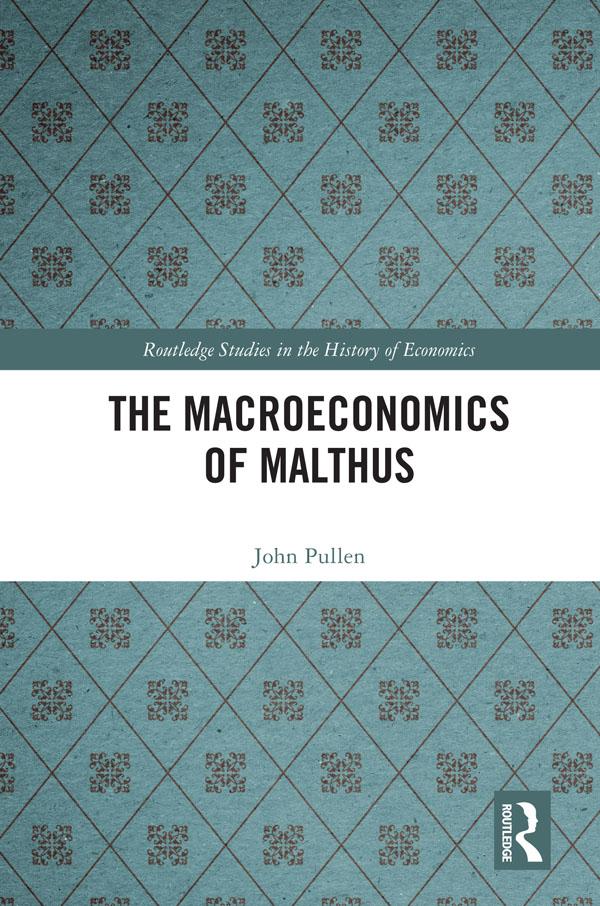
The views of Thomas Robert Malthus (1766–1834) on population, first published in his Essay on the Principle of Population, 1798, continue to be hotly debated, either acclaimed or opposed, as do his views on macroeconomics. There is a widely held view that his macroeconomics lacks coherence and is merely a collection of isolated jottings. This book challenges this view; it presents textual evidence that Malthus’s macroeconomics constitutes a significant system of thought with considerable academic merit.
It reawakens debate about the relative merits of Malthus and Ricardo as macroeconomists and contends that Malthus offers important macroeconomic ideas and policy proposals relevant to modern economic problems. It presents and analyses Malthus’ ideas on topics such as the determinants of aggregate economic growth; the causes of general depression; the remedies for mass unemployment; the balance between laissez-faire and government intervention; the optimum division of expenditure between consumption, saving, and investment; the distribution of income between wages, profits, and rents; and the degree of economic inequality. Particular emphasis is given to his view that the pattern of distribution of wealth between the upper, lower, and middle classes is a major determinant or factor in the production of wealth, and that continued economic development depends on the growth of a large and affluent middle class. The radical nature of some of his ideas and policy proposals on the ownership and distribution of land is highlighted. An extensive treatment of Say’s Law, incorporating aspects of the correspondence between Say and Malthus, addresses the question of whether Malthus showed that Say’s Law is merely a truism and lacks any scientific relevance. The book also sheds new light on the nature of the influence of Malthus on Keynes.
This combination of a search for textual authenticity and a critical assessment of the views of commentators on Malthus will be of significant interest to students and scholars of economic theory and the history of economics.
Paga fácilmente con tarjeta, Klarna, Apple Pay o Google Pay. ¿No estás contento? Siempre tienes 14 días de garantía de devolución. Lee más en nuestros términos. Si tienes preguntas, escríbenos a hello@memmo.org.
Memmo hace que estudiar sea más fácil, estés donde estés. Aquí tienes tus libros de texto y herramientas de estudio inteligentes en un solo lugar: resúmenes, quizzes, podcasts y flashcards. Y también a Ted, tu compañero de estudio que responde a todo lo que te preguntes. Más de 50 000 estudiantes ya estudian aquí. Está hecho para que aprendas más rápido y te estreses menos.