
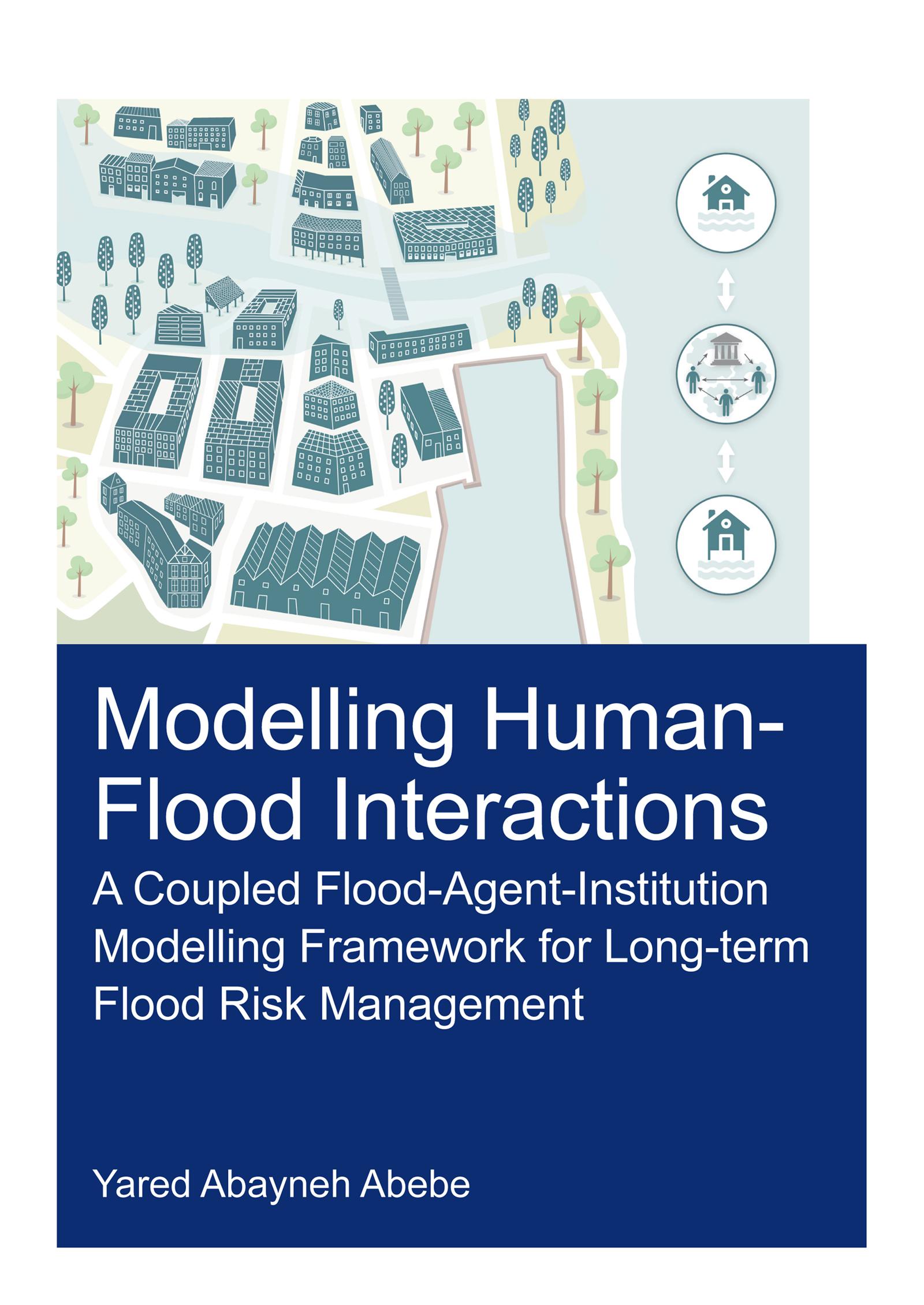
The negative impacts of floods are attributed to the extent and magnitude of a flood hazard, and the vulnerability and exposure of natural and human elements. In flood risk management (FRM) studies, it is crucial to model the interaction between human and flood subsystems across multiple spatial, temporal and organizational scales. Models should address the heterogeneity that exists within the human subsystem, and incorporate institutions that shape the behaviour of individuals. Hence, the main objectives of the dissertation are to develop a modelling framework and a methodology to build holistic models for FRM, and to assess how coupled human-flood interaction models support FRM policy analysis and decision-making. To achieve the objectives, the study introduces the Coupled fLood-Agent-Institution Modelling framework (CLAIM). CLAIM integrates actors, institutions, the urban environment, hydrologic and hydrodynamic processes and external factors, which affect FRM activities. The framework draws on the complex system perspective and conceptualizes the interaction of floods, humans and their environment as drivers of flood hazard, vulnerability and exposure. The human and flood subsystems are modelled using agent-based models and hydrodynamic models, respectively. The two models are dynamically coupled to understand human-flood interactions and to investigate the effect of institutions on FRM policy analysis.
Paga fácilmente con tarjeta, Klarna, Apple Pay o Google Pay. ¿No estás contento? Siempre tienes 14 días de garantía de devolución. Lee más en nuestros términos. Si tienes preguntas, escríbenos a hello@memmo.org.
Memmo hace que estudiar sea más fácil, estés donde estés. Aquí tienes tus libros de texto y herramientas de estudio inteligentes en un solo lugar: resúmenes, quizzes, podcasts y flashcards. Y también a Ted, tu compañero de estudio que responde a todo lo que te preguntes. Más de 50 000 estudiantes ya estudian aquí. Está hecho para que aprendas más rápido y te estreses menos.