
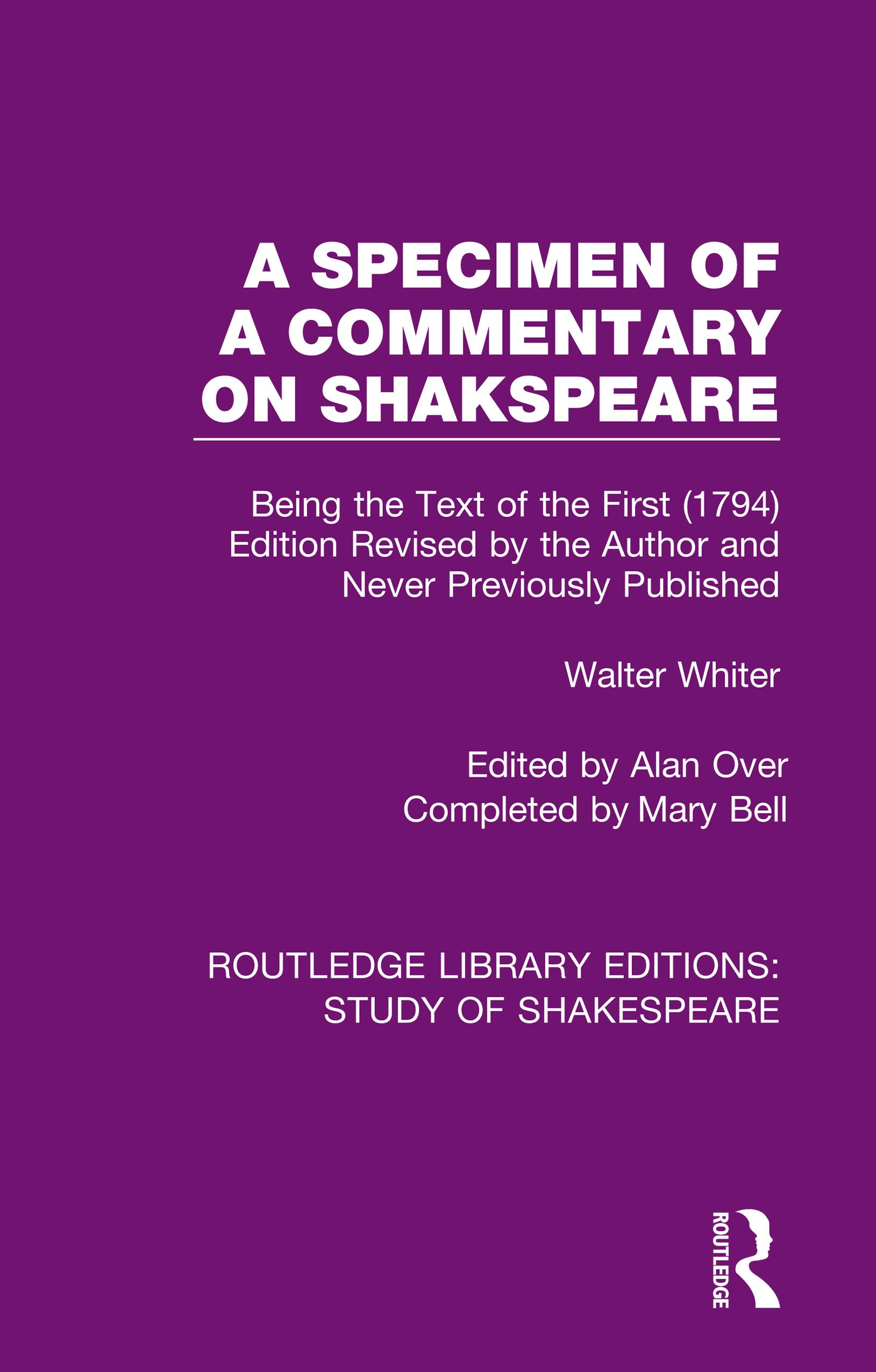
If it is not generally known that the foundations of twentieth-century criticism of Shakespeare’s imagery were laid over one hundred and fifty years ago, the explanation lies in the limited availability of the single original edition of Walter Whiter’s Specimen of a Commentary on Shakspeare published in 1794. In an age in which the study of Shakespeare’s characters was of prime interest and importance, Whiter – a classical scholar who took holy orders and ended his life as a country parson – developed a form of textual criticism closely linked to a study of the workings of the human mind: and his book offers a psychological survey of the creative imagination, following the principles laid down in Locke’s Essay on Human Understanding and illustrated by examples from Shakespeare’s plays. In his realization that Shakespeare provides the finest examples of the poetic imagination Whiter is of his time: but in his particular study of the associative powers of such a mind engaged in the process of creation, he is far in advance of his time and has no immediate disciples in the later nineteenth century. In the twentieth century, however, there was an increasing acknowledgement of Whiter’s work and a more frequent appeal for the reissue of his book. Originally published in 1967, the present edition was started in response to that appeal more than ten years before Mr Alan Over’s tragic death in 1964 and incorporates the revisions and additions made by Whiter for his own projected second edition.
Paga fácilmente con tarjeta, Klarna, Apple Pay o Google Pay. ¿No estás contento? Siempre tienes 14 días de garantía de devolución. Lee más en nuestros términos. Si tienes preguntas, escríbenos a hello@memmo.org.
Memmo hace que estudiar sea más fácil, estés donde estés. Aquí tienes tus libros de texto y herramientas de estudio inteligentes en un solo lugar: resúmenes, quizzes, podcasts y flashcards. Y también a Ted, tu compañero de estudio que responde a todo lo que te preguntes. Más de 50 000 estudiantes ya estudian aquí. Está hecho para que aprendas más rápido y te estreses menos.