
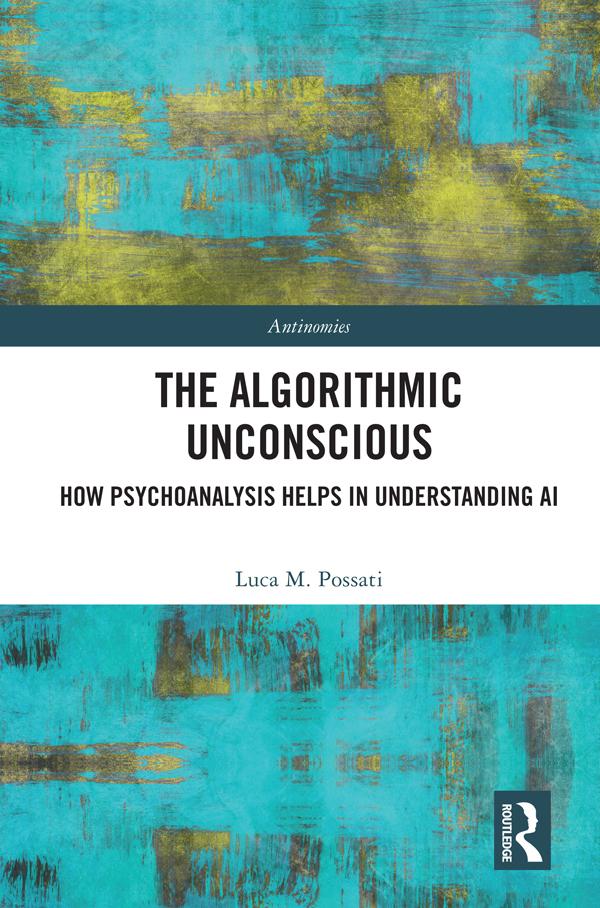
This book applies the concepts and methods of psychoanalysis to the study of artificial intelligence (AI) and human–AI interaction. It develops a new, more fruitful approach for applying psychoanalysis to AI and machine behavior. It appeals to a broad range of scholars: philosophers working on psychoanalysis, technology, AI ethics, and cognitive sciences, psychoanalysts, psychologists, and computer scientists.
The book is divided into four parts. The first part (Chapter 1) analyzes the concept of "machine behavior." The second part (Chapter 2) develops a reinterpretation of some fundamental Freudian and Lacanian concepts through Bruno Latour’s actor-network theory. The third part (Chapters 3 and 4) focuses on the nature and structure of the algorithmic unconscious. The author claims that the unconscious roots of AI lie in a form of projective identification, i.e., an emotional and imaginative exchange between humans and machines. In the fourth part of the book (Chapter 5), the author advances the thesis that neuropsychoanalysis and the affective neurosciences can provide a new paradigm for research on artificial general intelligence.
The Algorithmic Unconscious explores a completely new approach to AI, which can also be defined as a form of "therapy." Analyzing the projective identification processes that take place in groups of professional programmers and designers, as well as the "hidden" features of AI (errors, noise information, biases, etc.), represents an important tool to enable a healthy and positive relationship between humans and AI. Psychoanalysis is used as a critical space for reflection, innovation, and progress.
Paga fácilmente con tarjeta, Klarna, Apple Pay o Google Pay. ¿No estás contento? Siempre tienes 14 días de garantía de devolución. Lee más en nuestros términos. Si tienes preguntas, escríbenos a hello@memmo.org.
Memmo hace que estudiar sea más fácil, estés donde estés. Aquí tienes tus libros de texto y herramientas de estudio inteligentes en un solo lugar: resúmenes, quizzes, podcasts y flashcards. Y también a Ted, tu compañero de estudio que responde a todo lo que te preguntes. Más de 50 000 estudiantes ya estudian aquí. Está hecho para que aprendas más rápido y te estreses menos.