
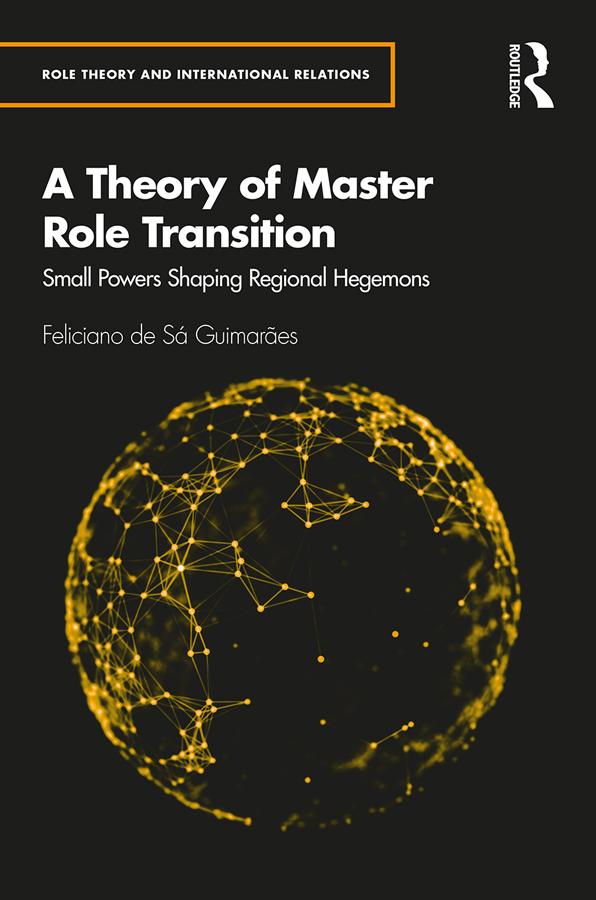
In this book, Feliciano de Sá Guimarães offers an original application of Role Theory. He proposes a theory of master role transitions to explain how small powers can change regional powers’ master roles without changing the regional material power distribution.
Master role transition is the replacement of an active dominant master role by a dormant or inactive role located within one’s role repertoire. Guimarães argues that only a combination of four necessary conditions can produce a full master role transition: asymmetrical material interdependence, altercasting, domestic contestation and regional contestation. In each one of these conditions, a small power uses material and ideational tools to promote a master role transition within the regional power role repertoire. To test his model, Guimarães turns to five case studies in Latin America, Southern Africa and South Asia: the 2006–2007 Bolivia–Brazil gas crisis, the 2008–2009 Paraguay–Brazil Itaipú Dam crisis, the 2008–2009 Ecuador–Brazil Odebrecht crisis, the 1998 South Africa–Lesotho military intervention crisis and the 1996India–Bangladesh Ganges water crisis.
A Theory of Master Role Transition is an excellent resource for those studying both theory and method in International Relations and foreign policy analysis.
Paga fácilmente con tarjeta, Klarna, Apple Pay o Google Pay. ¿No estás contento? Siempre tienes 14 días de garantía de devolución. Lee más en nuestros términos. Si tienes preguntas, escríbenos a hello@memmo.org.
Memmo hace que estudiar sea más fácil, estés donde estés. Aquí tienes tus libros de texto y herramientas de estudio inteligentes en un solo lugar: resúmenes, quizzes, podcasts y flashcards. Y también a Ted, tu compañero de estudio que responde a todo lo que te preguntes. Más de 50 000 estudiantes ya estudian aquí. Está hecho para que aprendas más rápido y te estreses menos.