
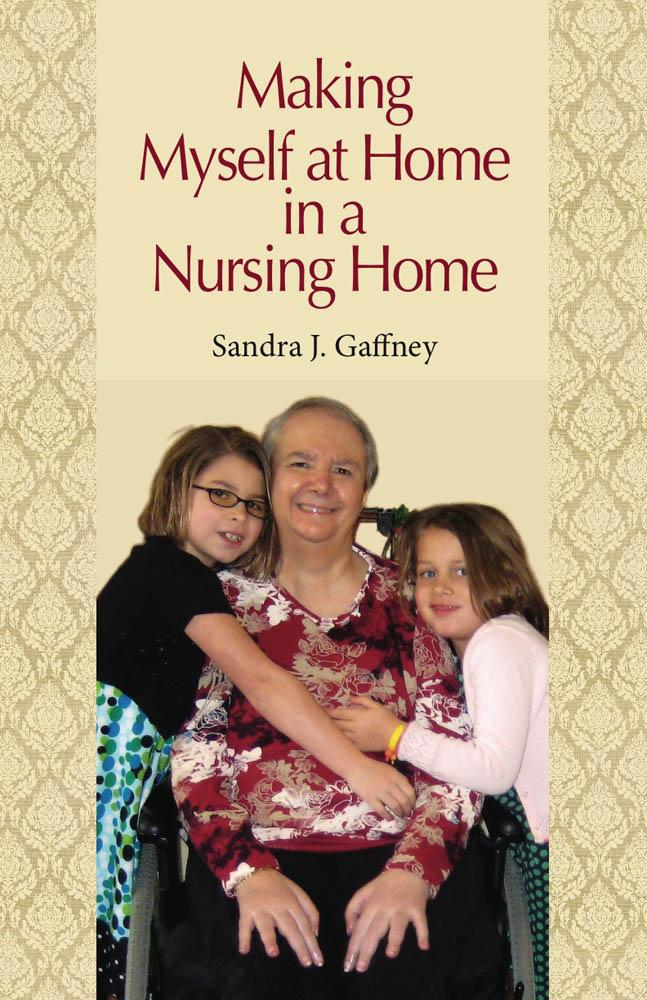
Sandra Gaffney entered her first nursing home for long-term care at the unusually young age of fifty. Fourteen years earlier she had been diagnosed with amyotrophic lateral sclerosis (ALS), also known as Lou Gehrig's disease. Over the next sixteen years, Gaffney lived in nursing homes in Florida, Virginia, and Minnesota, as the ways she could be close to family changed.
She describes her situation in these words: "As a nursing home resident, I require total or maximum care. I have limited use of my hands and arms. With special splints, I am able to turn the pages of my books, use the telephone and TV/VCR/FM radio remote control. When my cup is positioned properly, I can drink independently. I am able to walk with a platform walker and the help of two nursing assistants. My walking is not functional; it is only for exercise. After I moved into my third nursing home, I learned to operate a power wheelchair by using an adaptive switch between my knees. ... All other areas of physical care have to be done for me. My speech is impaired. If people listen carefully, they can understand what I am saying. ... I am able to eat regular food and breathe on my own."
Gaffney became an acute observer and strategist about how to live in a nursing home. Her first-person account, dictated to family members and assistants, covers making the decision to enter a nursing home, choosing the right one, and understanding its culture. She talks about how to furnish your room and about all the issues that arise in a resident's typical day. She has much to say about communication with staff and family about "how to help others help me." Gaffney's daughters, Amy and Bridget, and her friend Ellen Potter provide additional perspectives on the caregiving experience.
She describes her situation in these words: "As a nursing home resident, I require total or maximum care. I have limited use of my hands and arms. With special splints, I am able to turn the pages of my books, use the telephone and TV/VCR/FM radio remote control. When my cup is positioned properly, I can drink independently. I am able to walk with a platform walker and the help of two nursing assistants. My walking is not functional; it is only for exercise. After I moved into my third nursing home, I learned to operate a power wheelchair by using an adaptive switch between my knees. ... All other areas of physical care have to be done for me. My speech is impaired. If people listen carefully, they can understand what I am saying. ... I am able to eat regular food and breathe on my own."
Gaffney became an acute observer and strategist about how to live in a nursing home. Her first-person account, dictated to family members and assistants, covers making the decision to enter a nursing home, choosing the right one, and understanding its culture. She talks about how to furnish your room and about all the issues that arise in a resident's typical day. She has much to say about communication with staff and family about "how to help others help me." Gaffney's daughters, Amy and Bridget, and her friend Ellen Potter provide additional perspectives on the caregiving experience.
Paga fácilmente con tarjeta, Klarna, Apple Pay o Google Pay. ¿No estás contento? Siempre tienes 14 días de garantía de devolución. Lee más en nuestros términos. Si tienes preguntas, escríbenos a hello@memmo.org.
Memmo hace que estudiar sea más fácil, estés donde estés. Aquí tienes tus libros de texto y herramientas de estudio inteligentes en un solo lugar: resúmenes, quizzes, podcasts y flashcards. Y también a Ted, tu compañero de estudio que responde a todo lo que te preguntes. Más de 50 000 estudiantes ya estudian aquí. Está hecho para que aprendas más rápido y te estreses menos.
También te podría gustar
Comprar el libro0