
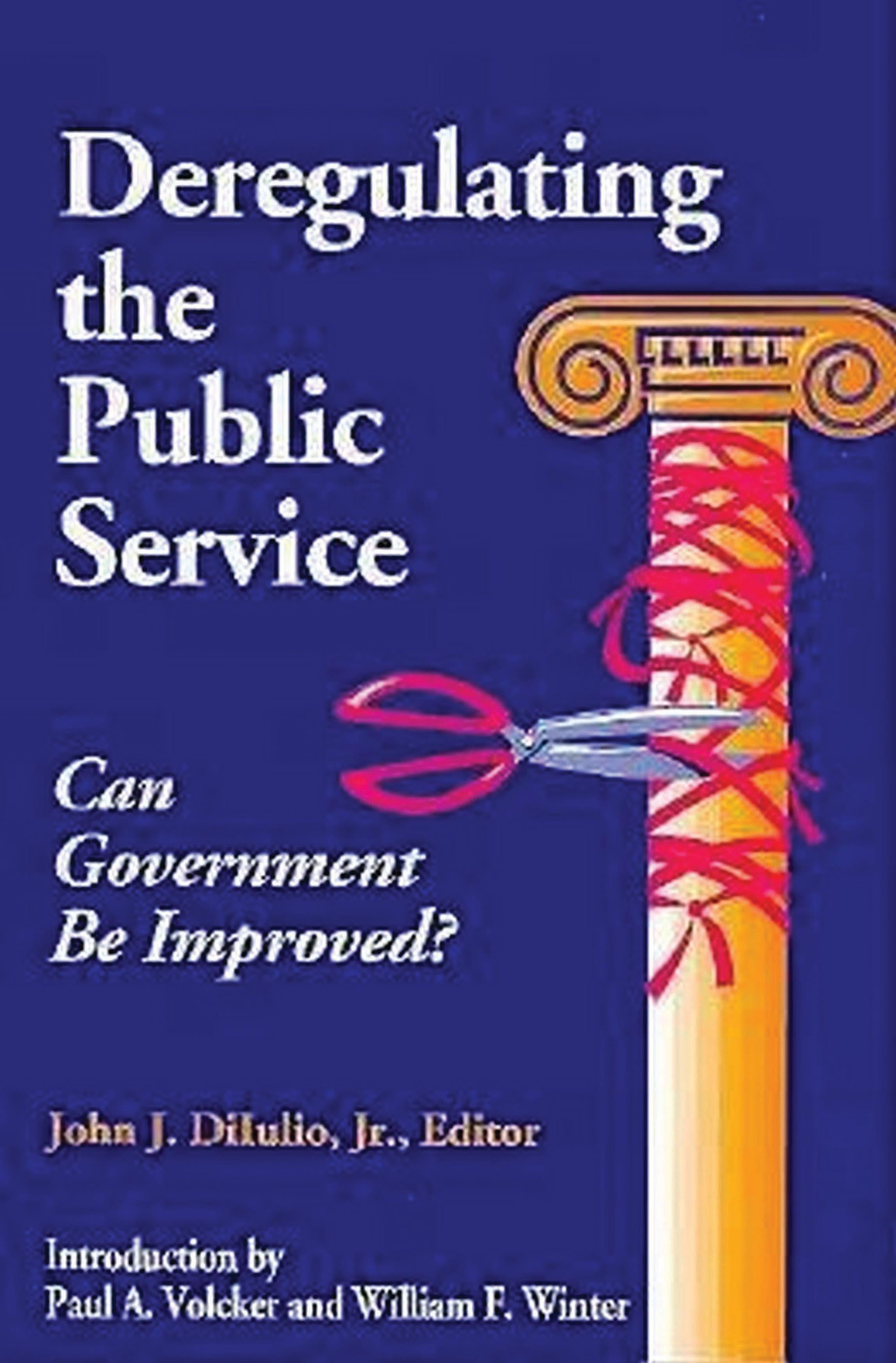
The nation's federal, state, and local public service is in deep trouble. Not even the most talented, dedicated, well-compensated, well-trained, and well-led public servants can serve the public well if they must operate under perverse personnel and procurement regulations that punish innovation and promote inefficiency. Many attempts have been made to determine administrative problems in the public service and come up with viable solutions. Two of the most importantthe 1990 report of the National Commission on the Public Service, led by former Federal Reserve chairman Paul A. Volcker, and the 1993 report of the National Commission on the State and Local Public Service, led by former Mississippi Governor William F. Winterrecommended ""deregulating the public service.""
Deregulating the public service essentially means altering or abolishing personnel and procurement regulations that deplete government workers' creativity, reduce their productivity, and make a career in public service unattractive to many talented, energetic, and public-spirited citizens. But will it work? With the benefit of a historical perspective on the development of American public service from the days of the progressives to the present, the contributors to this book argue that deregulating the public service is a necessary but insufficient condition for much of the needed improvement in governmental administration. Avoiding simple solutions and quick fixes for long-standing ills, they recommend new and large-scale experiments with deregulating the public service at all levels of government.
In addition to editor John DiIulio, the contributors are Paul A. Volcker, former chairman of the Federal Reserve, now at Princeton University; former Mississippi Governor William F. Winter; Gerald J. Garvey, Princeton; John P. Burke, University of Vermont; Melvin J. Dubnick, Rutgers; Constance Horner, former director of the Federal Office of Personnel Management, now at Brookings; Mark Alan Hughes, Harvard; Steven Kelman, Harvard; Donald F. Kettl, University of Wisconsin at Madison; Mark H. Moore, Harvard; Richard P. Nathan, State University of New York at Albany; Neal R. Peirce, The National Review; and James Q. Wilson, UCLA.
Deregulating the public service essentially means altering or abolishing personnel and procurement regulations that deplete government workers' creativity, reduce their productivity, and make a career in public service unattractive to many talented, energetic, and public-spirited citizens. But will it work? With the benefit of a historical perspective on the development of American public service from the days of the progressives to the present, the contributors to this book argue that deregulating the public service is a necessary but insufficient condition for much of the needed improvement in governmental administration. Avoiding simple solutions and quick fixes for long-standing ills, they recommend new and large-scale experiments with deregulating the public service at all levels of government.
In addition to editor John DiIulio, the contributors are Paul A. Volcker, former chairman of the Federal Reserve, now at Princeton University; former Mississippi Governor William F. Winter; Gerald J. Garvey, Princeton; John P. Burke, University of Vermont; Melvin J. Dubnick, Rutgers; Constance Horner, former director of the Federal Office of Personnel Management, now at Brookings; Mark Alan Hughes, Harvard; Steven Kelman, Harvard; Donald F. Kettl, University of Wisconsin at Madison; Mark H. Moore, Harvard; Richard P. Nathan, State University of New York at Albany; Neal R. Peirce, The National Review; and James Q. Wilson, UCLA.
Páginas: 338
Categoría: Statsvetenskap & Politik
e-ISBN: 9780815707196
Peso de envío: 1.2 kg
Envío en: 1-2 días
Paga fácilmente con tarjeta, Klarna, Apple Pay o Google Pay. ¿No estás contento? Siempre tienes 14 días de garantía de devolución. Lee más en nuestros términos. Si tienes preguntas, escríbenos a hello@memmo.org.
Memmo hace que estudiar sea más fácil, estés donde estés. Aquí tienes tus libros de texto y herramientas de estudio inteligentes en un solo lugar: resúmenes, quizzes, podcasts y flashcards. Y también a Ted, tu compañero de estudio que responde a todo lo que te preguntes. Más de 50 000 estudiantes ya estudian aquí. Está hecho para que aprendas más rápido y te estreses menos.