
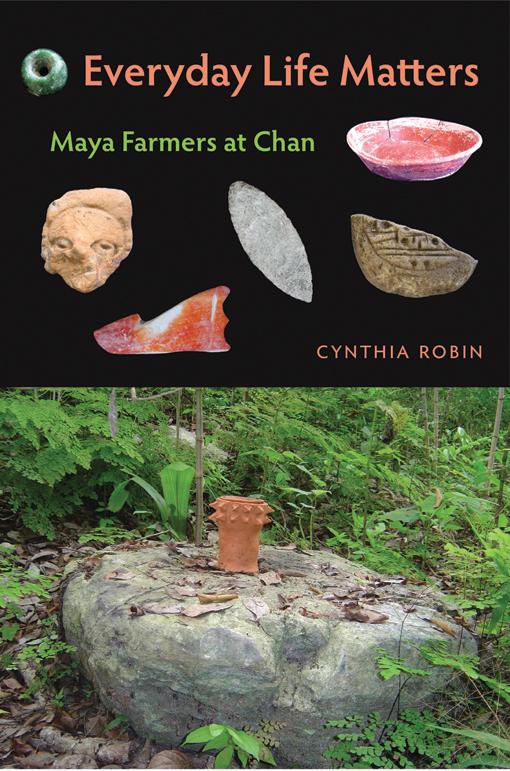
While the study of ancient civilizations has often focused on holy temples and royal tombs, a substantial part of the archaeological record remains hidden in the understudied day-to-day lives of artisans, farmers, hunters, and other ordinary people of the ancient world. The various chores of a person's daily life can be quite extraordinary and, even though they may seem trivial, such activities can have a powerful effect on society as a whole. Everyday Life Matters develops general methods and theories for studying everyday life applicable in archaeology, anthropology, and a wide range of disciplines.
In this groundbreaking work, Cynthia Robin examines the 2,000-year history (800 B.C.-A.D. 1200) of the ancient farming community of Chan in Belize, explaining why the average person should matter to archaeologists studying larger societal patterns. Robin argues that the impact of what is commonly perceived as habitual or quotidian can be substantial, and a study of a polity without regard to the citizenry is woefully incomplete. She also develops general methods and theories for studying everyday life applicable across a wide range of disciplines.
Refocusing attention from the Maya elite and offering critical analysis of daily life interwoven with larger anthropological theories, Robin engages us to consider the larger implications of the seemingly mundane and to rethink the constitution of human societies, everyday life, and ordinary people.
Paga fácilmente con tarjeta, Klarna, Apple Pay o Google Pay. ¿No estás contento? Siempre tienes 14 días de garantía de devolución. Lee más en nuestros términos. Si tienes preguntas, escríbenos a hello@memmo.org.
Memmo hace que estudiar sea más fácil, estés donde estés. Aquí tienes tus libros de texto y herramientas de estudio inteligentes en un solo lugar: resúmenes, quizzes, podcasts y flashcards. Y también a Ted, tu compañero de estudio que responde a todo lo que te preguntes. Más de 50 000 estudiantes ya estudian aquí. Está hecho para que aprendas más rápido y te estreses menos.