
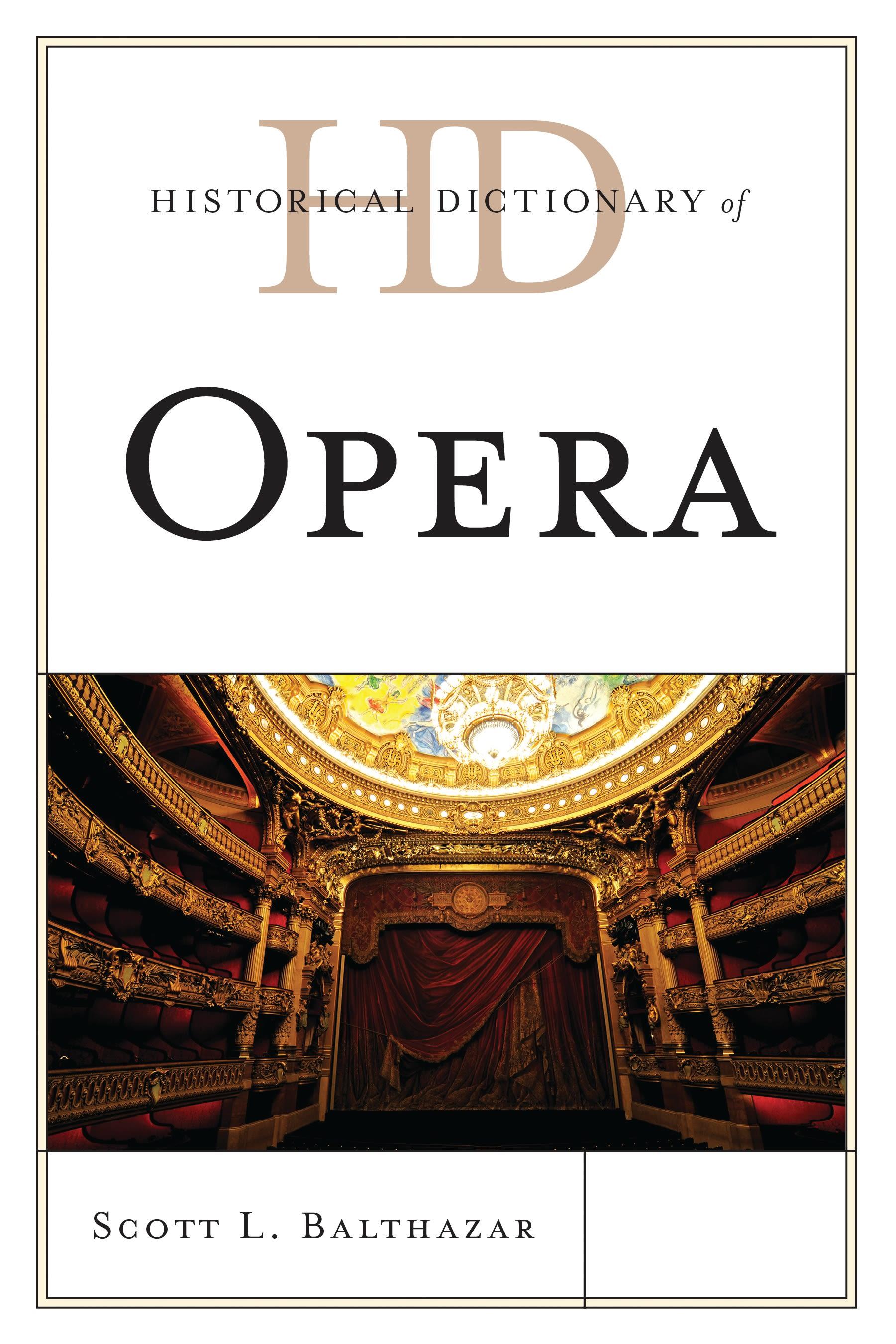
Opera has been around ever since the late 16th century, and it is still going strong in the sense that operas are performed around the world at present, and known by infinitely more persons than just those who attend performances. On the other hand, it has enjoyed periods in the past when more operas were produced to greater acclaim. Those periods inevitably have pride of place in this Historical Dictionary of Opera, as do exceptional singers, and others who combine to fashion the opera, whether or not they appear on stage. But this volume looks even further afield, considering the cities which were and still are opera centers, literary works which were turned into librettos, and types of pieces and genres. While some of the former can be found on the web or in other sources, most of the latter cannot and it is impossible to have the whole picture without them.
Indeed, this book has an amazingly broad scope. The dictionary section, with about 340 entries, covers the topics mentioned above but obviously focuses most on composers, not just the likes of Mozart, Verdi and Wagner, but others who are scarcely remembered but made notable contributions. Of course, there are the divas, but others singers as well, and some of the most familiar operas, Don Giovanni, Tosca and more. Technical terms also abound, and reference to different genres, from antimasque to zarzuela. Since opera has been around so long, the chronology is rather lengthy, since it has a lot of ground to cover, and the introduction sets the scene for the rest. This book should not be an end but rather a beginning, so it has a substantial bibliography for readers seeking more specific or specialized works. It is an excellent access point for readers interested in opera.
Indeed, this book has an amazingly broad scope. The dictionary section, with about 340 entries, covers the topics mentioned above but obviously focuses most on composers, not just the likes of Mozart, Verdi and Wagner, but others who are scarcely remembered but made notable contributions. Of course, there are the divas, but others singers as well, and some of the most familiar operas, Don Giovanni, Tosca and more. Technical terms also abound, and reference to different genres, from antimasque to zarzuela. Since opera has been around so long, the chronology is rather lengthy, since it has a lot of ground to cover, and the introduction sets the scene for the rest. This book should not be an end but rather a beginning, so it has a substantial bibliography for readers seeking more specific or specialized works. It is an excellent access point for readers interested in opera.
Paga fácilmente con tarjeta, Klarna, Apple Pay o Google Pay. ¿No estás contento? Siempre tienes 14 días de garantía de devolución. Lee más en nuestros términos. Si tienes preguntas, escríbenos a hello@memmo.org.
Memmo hace que estudiar sea más fácil, estés donde estés. Aquí tienes tus libros de texto y herramientas de estudio inteligentes en un solo lugar: resúmenes, quizzes, podcasts y flashcards. Y también a Ted, tu compañero de estudio que responde a todo lo que te preguntes. Más de 50 000 estudiantes ya estudian aquí. Está hecho para que aprendas más rápido y te estreses menos.