
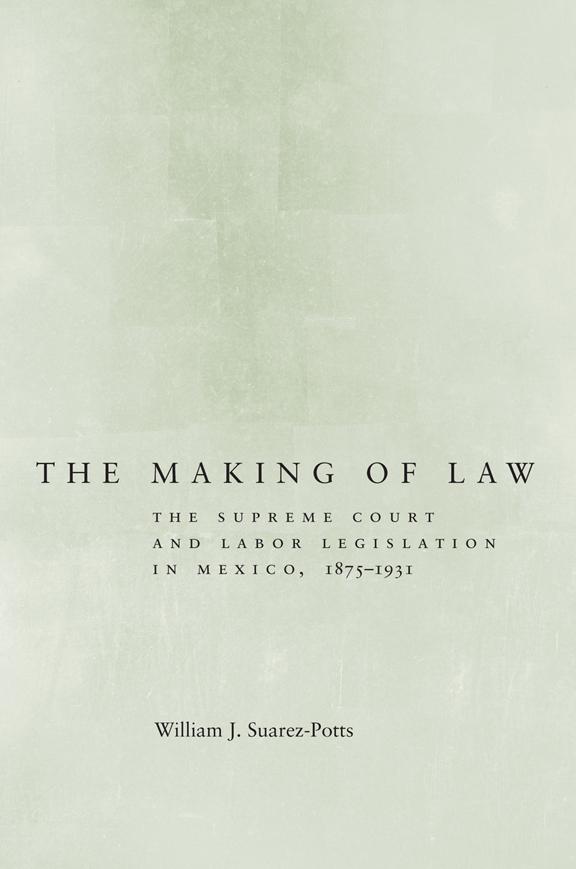
Despite Porfirio Díaz's authoritarian rule (1877-1911) and the fifteen years of violent conflict typifying much of Mexican politics after 1917, law and judicial decision-making were important for the country's political and economic organization. Influenced by French theories of jurisprudence in addition to domestic events, progressive Mexican legal thinkers concluded that the liberal view of law—as existing primarily to guarantee the rights of individuals and of private property—was inadequate for solving the "social question"; the aim of the legal regime should instead be one of harmoniously regulating relations between interdependent groups of social actors. This book argues that the federal judiciary's adjudication of labor disputes and its elaboration of new legal principles played a significant part in the evolution of Mexican labor law and the nation's political and social compact. Indeed, this conclusion might seem paradoxical in a country with a civil law tradition, weak judiciary, authoritarian government, and endemic corruption. Suarez-Potts shows how and why judge-made law mattered, and why contemporaries paid close attention to the rulings of Supreme Court justices in labor cases as the nation's system of industrial relations was established.
Paga fácilmente con tarjeta, Klarna, Apple Pay o Google Pay. ¿No estás contento? Siempre tienes 14 días de garantía de devolución. Lee más en nuestros términos. Si tienes preguntas, escríbenos a hello@memmo.org.
Memmo hace que estudiar sea más fácil, estés donde estés. Aquí tienes tus libros de texto y herramientas de estudio inteligentes en un solo lugar: resúmenes, quizzes, podcasts y flashcards. Y también a Ted, tu compañero de estudio que responde a todo lo que te preguntes. Más de 50 000 estudiantes ya estudian aquí. Está hecho para que aprendas más rápido y te estreses menos.