
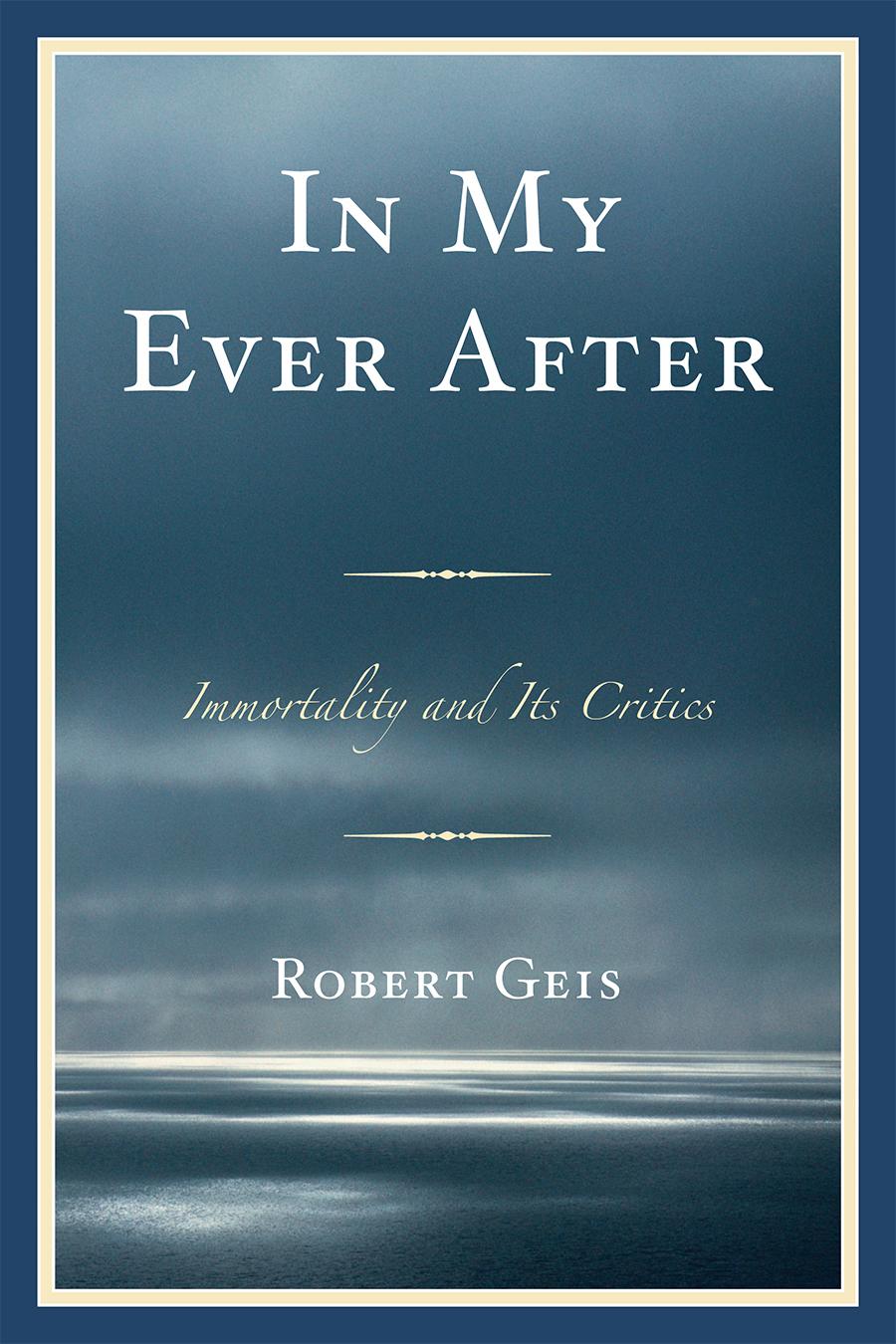
In My Ever After is not a mass media style "general readership" book on immortality; rather, it is an argument against a current school -- neurophilosophy's virtual equation of consciousness and the world. Without exposing the equation's weaknesses, the question of immortality, Geis argues, is moot. Part I identifies many epistemic and scientific grounds for a real world outside consciousness and self-refutational flaws in quantum physics. It employs the phenomenological method to situate "consciousness" and "other" in their relations. Part II sets forth why consciousness cannot be electrical in origin, and then how partibility and subjectivity, in tandem with the power of conceptualization, evince reasons for accepting immortal consciousness as a condition of all human awareness. A discussion of why pharmacologic explanations for the OBE and NDE are wanting, plus neurologic arguments for memory's non-localizability, and how animal sentience adds to philosophic conviction coordinate with Scripture on animal existence beyond the grave, concludes the argument.
Paga fácilmente con tarjeta, Klarna, Apple Pay o Google Pay. ¿No estás contento? Siempre tienes 14 días de garantía de devolución. Lee más en nuestros términos. Si tienes preguntas, escríbenos a hello@memmo.org.
Memmo hace que estudiar sea más fácil, estés donde estés. Aquí tienes tus libros de texto y herramientas de estudio inteligentes en un solo lugar: resúmenes, quizzes, podcasts y flashcards. Y también a Ted, tu compañero de estudio que responde a todo lo que te preguntes. Más de 50 000 estudiantes ya estudian aquí. Está hecho para que aprendas más rápido y te estreses menos.