
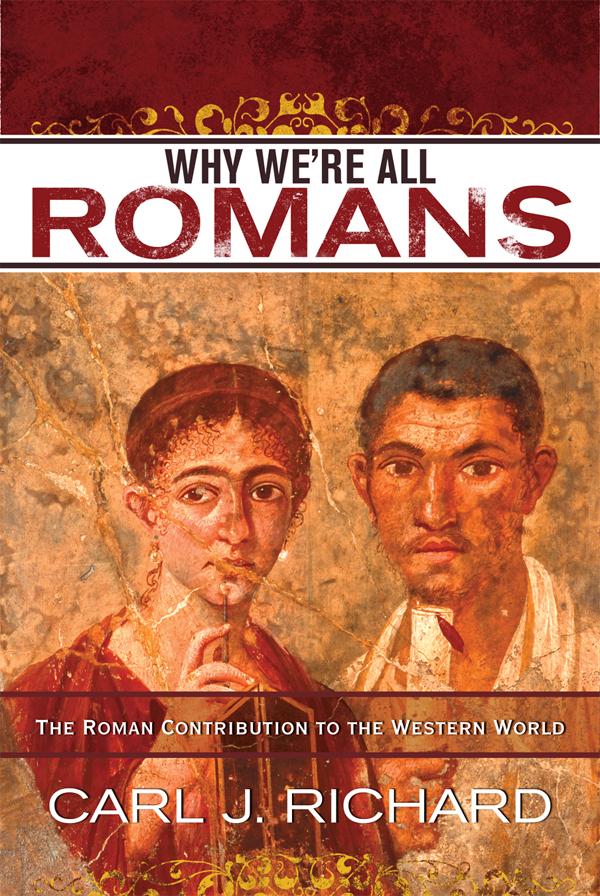
This engaging yet deeply informed work not only examines Roman history and the multitude of Roman achievements in rich and colorful detail but also delineates their crucial and lasting impact on Western civilization. Noted historian Carl J. Richard argues that although we Westerners are "all Greeks" in politics, science, philosophy, and literature and "all Hebrews" in morality and spirituality, it was the Romans who made us Greeks and Hebrews.
As the author convincingly shows, from the Middle Ages on, most Westerners received Greek ideas from Roman sources. Similarly, when the Western world adopted the ethical monotheism of the Hebrews, it did so at the instigation of a Roman citizen named Paul, who took advantage of the peace, unity, stability, and roads of the empire to proselytize the previously pagan Gentiles, who quickly became a majority of the religion's adherents. Although the Roman government of the first century crucified Christ and persecuted Christians, Rome's fourth- and fifth-century leaders encouraged the spread of Christianity throughout the Western world.
In addition to making original contributions to administration, law, engineering, and architecture, the Romans modified and often improved the ideas they assimilated. Without the Roman sense of social responsibility to temper the individualism of Hellenistic Greece, classical culture might have perished, and without the Roman masses to proselytize and the social and material conditions necessary to this evangelism, Christianity itself might not have survived.
As the author convincingly shows, from the Middle Ages on, most Westerners received Greek ideas from Roman sources. Similarly, when the Western world adopted the ethical monotheism of the Hebrews, it did so at the instigation of a Roman citizen named Paul, who took advantage of the peace, unity, stability, and roads of the empire to proselytize the previously pagan Gentiles, who quickly became a majority of the religion's adherents. Although the Roman government of the first century crucified Christ and persecuted Christians, Rome's fourth- and fifth-century leaders encouraged the spread of Christianity throughout the Western world.
In addition to making original contributions to administration, law, engineering, and architecture, the Romans modified and often improved the ideas they assimilated. Without the Roman sense of social responsibility to temper the individualism of Hellenistic Greece, classical culture might have perished, and without the Roman masses to proselytize and the social and material conditions necessary to this evangelism, Christianity itself might not have survived.
Paga fácilmente con tarjeta, Klarna, Apple Pay o Google Pay. ¿No estás contento? Siempre tienes 14 días de garantía de devolución. Lee más en nuestros términos. Si tienes preguntas, escríbenos a hello@memmo.org.
Memmo hace que estudiar sea más fácil, estés donde estés. Aquí tienes tus libros de texto y herramientas de estudio inteligentes en un solo lugar: resúmenes, quizzes, podcasts y flashcards. Y también a Ted, tu compañero de estudio que responde a todo lo que te preguntes. Más de 50 000 estudiantes ya estudian aquí. Está hecho para que aprendas más rápido y te estreses menos.