
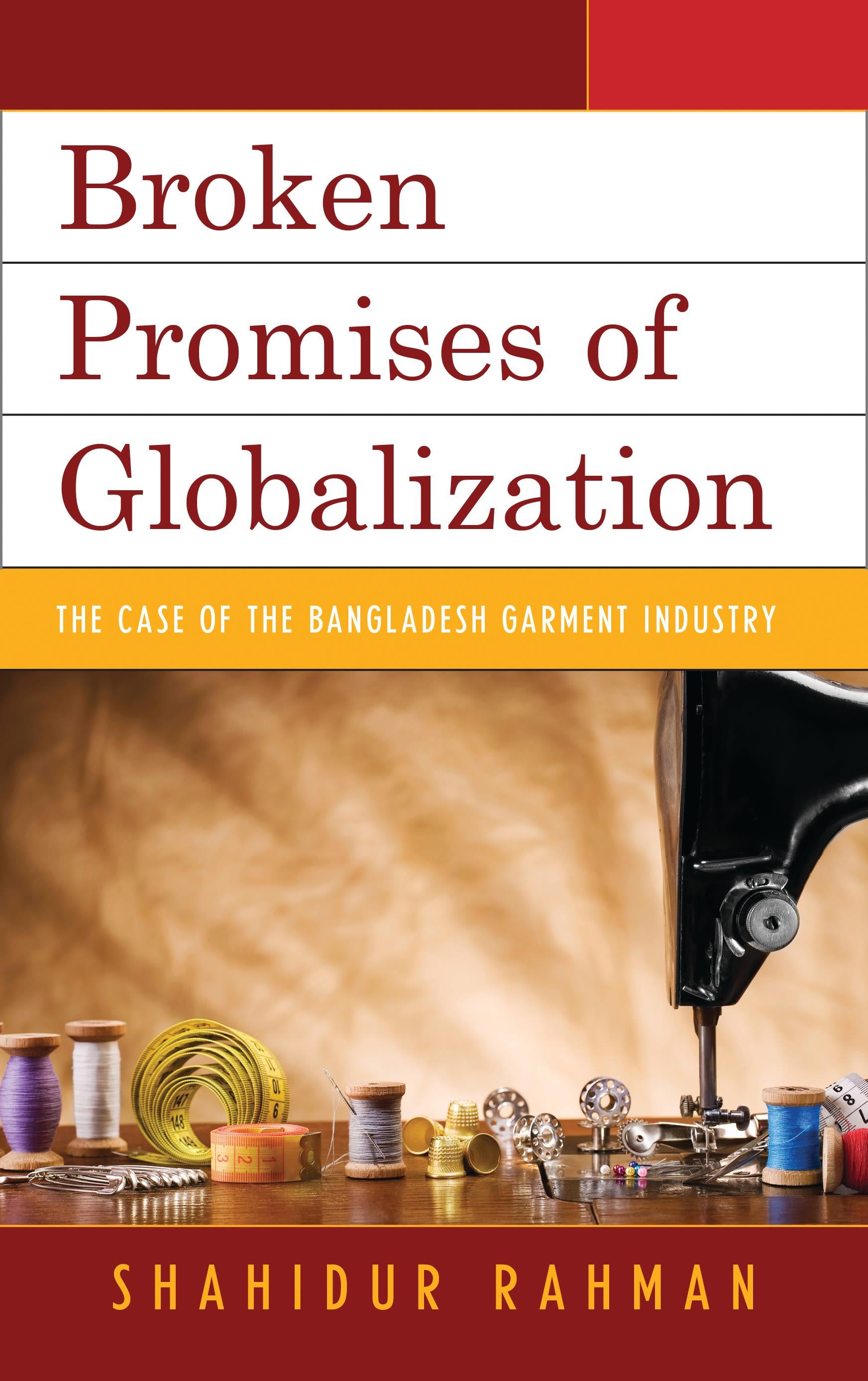
Broken Promises of Globalization: The Case of the Bangladesh Garment Industry analyzes the consequences of the latest wave of globalization within the context of the Bangladesh garment industry's integration into world markets and production chains. Shahidur Rahman has found that although globalization has created opportunities, the process of globalization has also triggered a deformed development leaving Bangladesh increasingly vulnerable to shifts and tensions within the world trading regime. Bangladesh’s vulnerability, experienced as a constraining framework by all the major actors in dependent industrialization, is of particular importance to the progress both of workers and of Bangladesh’s industrializing modernizers in the garment industry.
This book intends to respond to three questions. First, has the garment industry been able to counteract the vulnerability that women garment workers had experienced in their villages? Second, is the formation of a welfare committee a substitute model for unions when it comes to protecting women’s rights? Finally, how is a Least Developing Country dealing with both domestic and external pressures in its response to globalization? Rahman argues that in spite of the opportunities created by the growth of the garment industry, the key actors such as workers, entrepreneurs, unions, and even the government have become vulnerable in the process of the global integration of this industry. This is an ethnographic study that tells the story of the rise, growth, and demise of a Bangladeshi garment company. From a broader approach, an internal force such as the government of Bangladesh is not alone in being responsible for pushing the workers into a vulnerable position; external pressure on the state is also responsible for intensifying the vulnerability of Bangladeshi institutions and actors. Broken Promises of Globalization exposes the crisis Bangladeshi garment companies face as a result of the momentous pressures emanating from the regime of neo-liberal globalization.
This ethnographic study, exploring a wide range of contemporary and recent development issues, holds particular relevance for students and scholars of sociology, political science, political economics, labor, and development studies.
This book intends to respond to three questions. First, has the garment industry been able to counteract the vulnerability that women garment workers had experienced in their villages? Second, is the formation of a welfare committee a substitute model for unions when it comes to protecting women’s rights? Finally, how is a Least Developing Country dealing with both domestic and external pressures in its response to globalization? Rahman argues that in spite of the opportunities created by the growth of the garment industry, the key actors such as workers, entrepreneurs, unions, and even the government have become vulnerable in the process of the global integration of this industry. This is an ethnographic study that tells the story of the rise, growth, and demise of a Bangladeshi garment company. From a broader approach, an internal force such as the government of Bangladesh is not alone in being responsible for pushing the workers into a vulnerable position; external pressure on the state is also responsible for intensifying the vulnerability of Bangladeshi institutions and actors. Broken Promises of Globalization exposes the crisis Bangladeshi garment companies face as a result of the momentous pressures emanating from the regime of neo-liberal globalization.
This ethnographic study, exploring a wide range of contemporary and recent development issues, holds particular relevance for students and scholars of sociology, political science, political economics, labor, and development studies.
Paga fácilmente con tarjeta, Klarna, Apple Pay o Google Pay. ¿No estás contento? Siempre tienes 14 días de garantía de devolución. Lee más en nuestros términos. Si tienes preguntas, escríbenos a hello@memmo.org.
Memmo hace que estudiar sea más fácil, estés donde estés. Aquí tienes tus libros de texto y herramientas de estudio inteligentes en un solo lugar: resúmenes, quizzes, podcasts y flashcards. Y también a Ted, tu compañero de estudio que responde a todo lo que te preguntes. Más de 50 000 estudiantes ya estudian aquí. Está hecho para que aprendas más rápido y te estreses menos.