
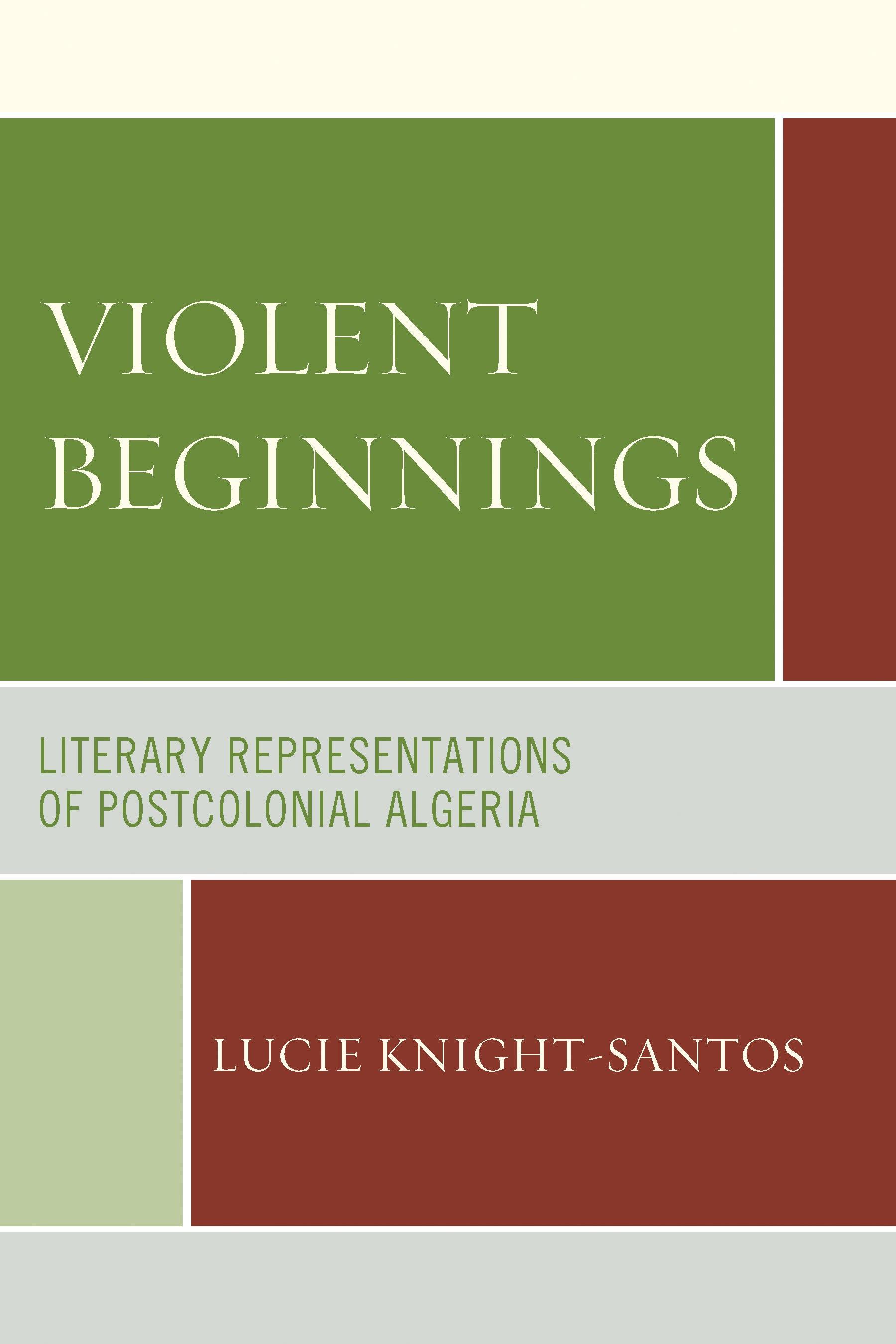
From a colonial campaign that was envisioned by France as the redemption of its Algerian “children" through Western civilization to Algerian Independence that was lived by both parties as a bloody divorce; recent Algerian history has been imagined and represented in terms of the family. Prominent authors such as Kateb Yacine and Mouloud Mammeri pondered their own fate during the War of Independence as the “mixed” children of a failed colonial marriage. Contemporary postcolonial authors such as Rachid Boudjedra, Yasmina Salah, and Arezki Mellal have filled their narratives with orphaned children searching for ideal parents as a civil war ripped Algeria apart in the 1990s.
Violent Beginnings: Literary Representations of Postcolonial Algeria explores how violence, during the War of Independence (1954–1962) to the more recent civil war (1991–2002), has shaped literary representations of both family and nation in contemporary literature. For example, discussions of the struggle for independence in Assia Djebar’s La femme sans sépulture and Ahlam Mostaghanemi’s Memory of the Flesh, represent sexual torture associated with this earlier war period as having a negative impact on victims’ ability to have children and contribute to the development of the Algerian nation. Texts examining the more recent civil war such as Rachid Boudjedra’s La vie à l’endroit and Yasmina Salah’s Glass Nation establish a link between the earlier violence of the independence struggle and contemporary events. Additionally, these texts proceed todemonstrate how violence has shaped familial and national structures, more specifically causing distorted familial bonds and political chaos in contemporary Algerian society.
Violent Beginnings: Literary Representations of Postcolonial Algeria explores how violence, during the War of Independence (1954–1962) to the more recent civil war (1991–2002), has shaped literary representations of both family and nation in contemporary literature. For example, discussions of the struggle for independence in Assia Djebar’s La femme sans sépulture and Ahlam Mostaghanemi’s Memory of the Flesh, represent sexual torture associated with this earlier war period as having a negative impact on victims’ ability to have children and contribute to the development of the Algerian nation. Texts examining the more recent civil war such as Rachid Boudjedra’s La vie à l’endroit and Yasmina Salah’s Glass Nation establish a link between the earlier violence of the independence struggle and contemporary events. Additionally, these texts proceed todemonstrate how violence has shaped familial and national structures, more specifically causing distorted familial bonds and political chaos in contemporary Algerian society.
Paga fácilmente con tarjeta, Klarna, Apple Pay o Google Pay. ¿No estás contento? Siempre tienes 14 días de garantía de devolución. Lee más en nuestros términos. Si tienes preguntas, escríbenos a hello@memmo.org.
Memmo hace que estudiar sea más fácil, estés donde estés. Aquí tienes tus libros de texto y herramientas de estudio inteligentes en un solo lugar: resúmenes, quizzes, podcasts y flashcards. Y también a Ted, tu compañero de estudio que responde a todo lo que te preguntes. Más de 50 000 estudiantes ya estudian aquí. Está hecho para que aprendas más rápido y te estreses menos.