
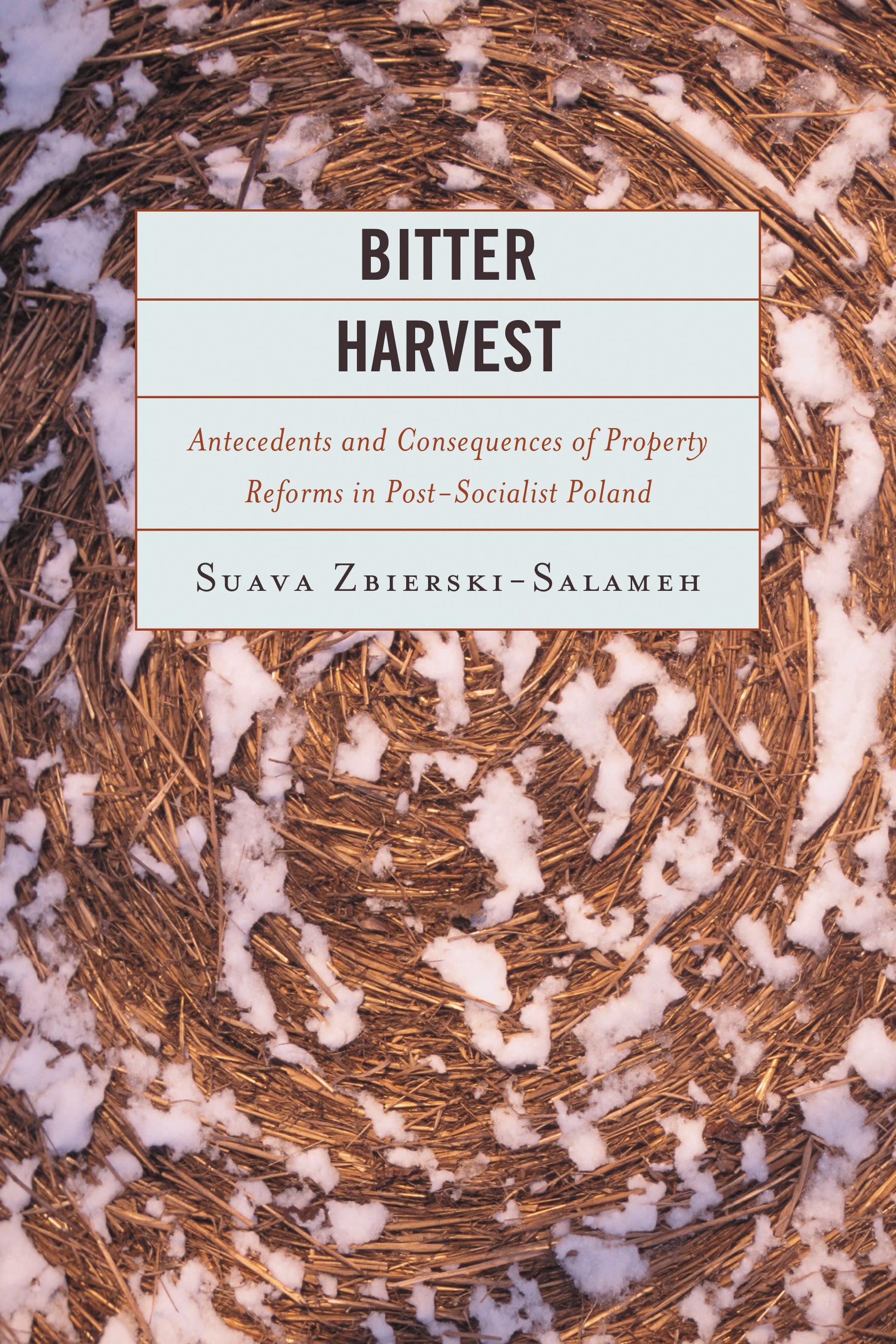
Bitter Harvest, a historical ethnographic study, examines the property changes prompted by the early post-socialist neoliberal reforms designed to build capitalism in Poland. Historically, the book traces the halting but steady emergence of privatization and liberalization, even under socialism, and how these anticipated the reforms of the post-socialist period. Contrary to the view that the 1989 post-socialist policy represented a radical departure from former state socialist policies via the importation of Western “shock therapy” reforms, including the key economic institution of private property, this book dispenses with the sharp divide between the “socialist past” and “capitalist present” and argues the lasting importance of these historical antecedents in shaping both post-socialist policy and responses to it. Ethnographically, the book provides a detailed account of the different yet interdependent ways the post-socialist reform program influenced existing agricultural property forms—small farmers, production cooperatives, and state farms—leading in each case to unexpected economic results and political contestation of the policy objectives.
This historical and ethnographic study of multiple forms of ownership poses a challenge to the common conception of a homogenized socialism based on state property. It also refutes the reductionist representation of the reality after socialism as the creation of Western-style, private property–based economic systems, unaffected by the unique Eastern European sociopolitical context. Instead, looking at Poland’s property changes through the eyes and experiences of diverse agricultural owners, this book employs the notion of conjoint property to unpack the complexity of ownership under socialism and theorize its evolution into an incomplete exclusive ownership after socialism. This new conceptual framework of property changes in early transition helps us to understand current developments in Eastern Europe as it integrates with the European Union and intersects with global capitalism. It further sheds light on the limits of the universality of the Western notion of private property.
This historical and ethnographic study of multiple forms of ownership poses a challenge to the common conception of a homogenized socialism based on state property. It also refutes the reductionist representation of the reality after socialism as the creation of Western-style, private property–based economic systems, unaffected by the unique Eastern European sociopolitical context. Instead, looking at Poland’s property changes through the eyes and experiences of diverse agricultural owners, this book employs the notion of conjoint property to unpack the complexity of ownership under socialism and theorize its evolution into an incomplete exclusive ownership after socialism. This new conceptual framework of property changes in early transition helps us to understand current developments in Eastern Europe as it integrates with the European Union and intersects with global capitalism. It further sheds light on the limits of the universality of the Western notion of private property.
Paga fácilmente con tarjeta, Klarna, Apple Pay o Google Pay. ¿No estás contento? Siempre tienes 14 días de garantía de devolución. Lee más en nuestros términos. Si tienes preguntas, escríbenos a hello@memmo.org.
Memmo hace que estudiar sea más fácil, estés donde estés. Aquí tienes tus libros de texto y herramientas de estudio inteligentes en un solo lugar: resúmenes, quizzes, podcasts y flashcards. Y también a Ted, tu compañero de estudio que responde a todo lo que te preguntes. Más de 50 000 estudiantes ya estudian aquí. Está hecho para que aprendas más rápido y te estreses menos.