
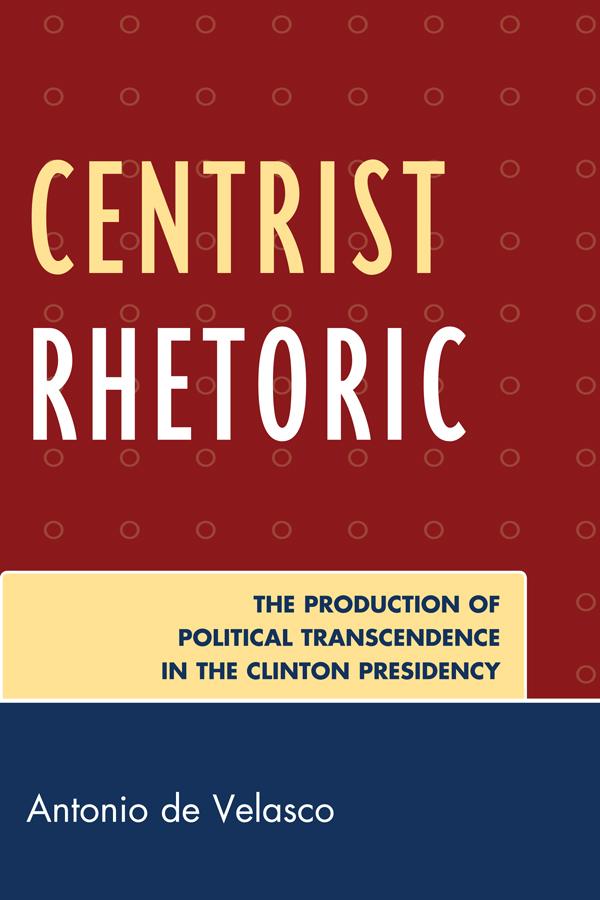
What exactly is happening when politicians evoke a center space beyond partisan politics to advance what are unmistakably political arguments? Drawing from an analysis of pivotal speeches surrounding Bill Clinton's 1992 presidential campaign and first term in office, Centrist Rhetoric: The Production of Political Transcendence in the Clinton Presidency takes an extended look at this question by showing how the possibility of political transcendence takes form in the rhetoric of the political center.
Faced with a divided and shrinking party, and later with a pitched battle against a resurgent conservative movement, Clinton used the image of a political center, a "third way" beyond liberal and conservative orthodoxies, to advance his strategic goals, define his adversaries, and overcome key political challenges. As appeals to the center helped Clinton to achieve these advantages in specific cases, however, they also served to define the means, ends, and very essence of democracy in ambiguous and contradictory ways. Touching on controversies from the early 1990s over the future of the Democratic Party, racial identity in American politics, the threat of rightwing extremism, and the role of government, Antonio de Velasco show how centrist rhetoric's call to transcendence weaved together forms of identification and division, insight and blindness, so as to defy the conventional assessments of both Clinton's supporters and his detractors.
Centrist Rhetoric thus offers general insight into the workings of political rhetoric, and a specific appreciation of Clinton's attempts to define and adjust to the political exigencies of a critical period in history of the Democratic Party and politics in the United States.
Faced with a divided and shrinking party, and later with a pitched battle against a resurgent conservative movement, Clinton used the image of a political center, a "third way" beyond liberal and conservative orthodoxies, to advance his strategic goals, define his adversaries, and overcome key political challenges. As appeals to the center helped Clinton to achieve these advantages in specific cases, however, they also served to define the means, ends, and very essence of democracy in ambiguous and contradictory ways. Touching on controversies from the early 1990s over the future of the Democratic Party, racial identity in American politics, the threat of rightwing extremism, and the role of government, Antonio de Velasco show how centrist rhetoric's call to transcendence weaved together forms of identification and division, insight and blindness, so as to defy the conventional assessments of both Clinton's supporters and his detractors.
Centrist Rhetoric thus offers general insight into the workings of political rhetoric, and a specific appreciation of Clinton's attempts to define and adjust to the political exigencies of a critical period in history of the Democratic Party and politics in the United States.
Paga fácilmente con tarjeta, Klarna, Apple Pay o Google Pay. ¿No estás contento? Siempre tienes 14 días de garantía de devolución. Lee más en nuestros términos. Si tienes preguntas, escríbenos a hello@memmo.org.
Memmo hace que estudiar sea más fácil, estés donde estés. Aquí tienes tus libros de texto y herramientas de estudio inteligentes en un solo lugar: resúmenes, quizzes, podcasts y flashcards. Y también a Ted, tu compañero de estudio que responde a todo lo que te preguntes. Más de 50 000 estudiantes ya estudian aquí. Está hecho para que aprendas más rápido y te estreses menos.